
TL;DR

Turn your wind-down time into listening time
- Thousands of audiobooks, podcasts and originals
- Listen on your phone, tablet or Echo — also offline
- Cancel anytime
A multicenter study of 506 adults receiving physician-led home care in Tokyo and Ibaraki found that 94.7% had two or more chronic conditions. Patients with four or more conditions were more likely to have an emergency home visit than those with two or three, though the study does not establish that multimorbidity caused those visits.
A study of 506 adults receiving physician-led home care in Tokyo and Ibaraki Prefecture found that 94.7% had at least two chronic conditions, the definition of multimorbidity used by the researchers. The University of Tsukuba team also found that people with higher condition counts were more likely to need an emergency home visit, a finding that could help care teams identify patients who may need closer planning and follow-up.
Researchers examined patients’ medical records to count their chronic conditions and assess whether they had received an unscheduled physician visit at home following a sudden change in their health. The study was published in the Journal of General and Family Medicine. The report identifies the work as a multicenter study involving patients receiving care from medical facilities in Tokyo and Ibaraki Prefecture.
More than half of the participants, 57.1%, had four or more chronic conditions. Overall, 13.2% had at least one emergency home visit during the month before the assessment. Compared with patients who had two or three conditions, those with four or five—and particularly those with six or more—were significantly more likely to have required such a visit.
The researchers grouped patients by the number of chronic conditions and examined how those groups related to emergency visits. The reported results show an association, not proof that having additional conditions directly caused an emergency visit. The study summary does not specify which individual conditions were most common or provide further detail about the emergency events.
Condition Counts May Flag Home-Care Risk
The results point to the complexity of caring for people who rely on home-based medical services. When nearly all patients in a study population have multiple chronic conditions, clinicians may need to plan care around overlapping health needs rather than treating each diagnosis in isolation. The finding that emergency visits were more likely among patients with higher condition counts suggests that a straightforward tally of chronic conditions could be one part of identifying people who may need more proactive attention.
That tally would be a potential screening aid, not a standalone prediction or a substitute for clinical judgment. The study summary does not show whether using condition counts to change care plans would reduce emergency visits, improve health outcomes or lower costs. It also does not establish that the results apply to every home-care patient in Japan, or to patients in other countries.
As an affiliate, we earn on qualifying purchases.
Home Care in an Aging Japan
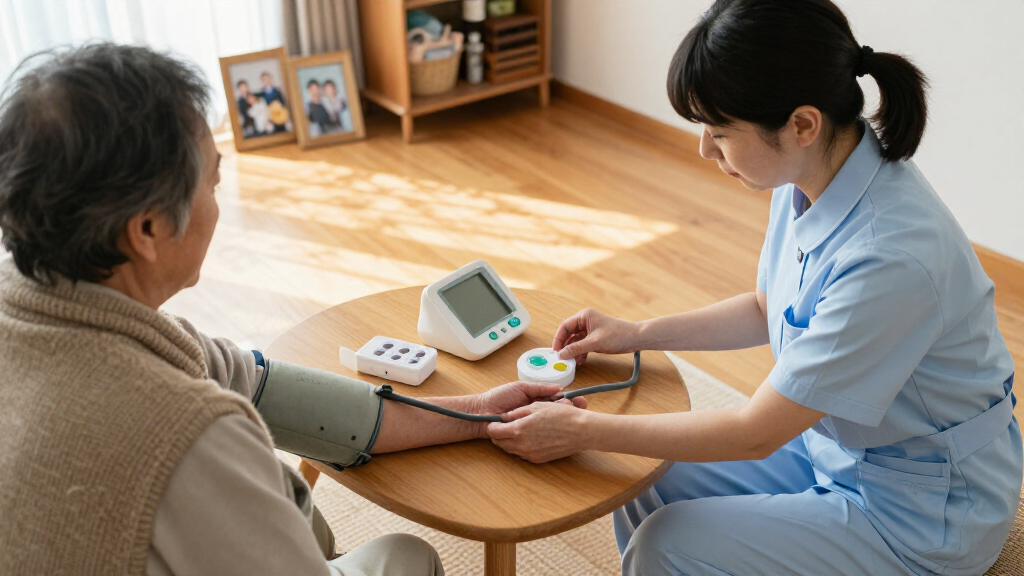
Home-based medical care allows physicians to visit people who have difficulty traveling to clinics or hospitals. The report describes this service as increasingly relevant as Japan’s population ages and more older adults receive care at home. Despite multimorbidity being understood as common in this setting, the study authors said relatively few studies had measured its prevalence among home-care patients.
The research, led by Gen Nakayama and colleagues at the University of Tsukuba, addresses that gap with records from 506 adults served by medical facilities in two areas. The paper, titled “Multimorbidity Among Patients Receiving Home Care in Japan: Prevalence, Levels, and Association With Emergency Home Visits,” appeared in the Journal of General and Family Medicine in 2026. Its DOI is 10.1002/jgf2.70170.
Limits of the Reported Findings
The available report does not provide several details needed to judge how broadly the findings can be applied. It does not specify the participants’ age distribution, how long records were reviewed for chronic conditions, how patients were selected, or how many people were in each condition-count group. The report also does not give the size of the increased likelihood of emergency visits or a confidence interval, so the scale and precision of that association cannot be assessed from the summary alone.
The reported comparison does not establish that multimorbidity caused emergency visits. Other patient characteristics or circumstances could also be related to both the number of conditions and the need for urgent care. It is also unclear whether the study followed patients beyond the month used to report emergency visits, or whether the findings would hold in other regions or health systems.
How Care Teams Could Use the Results
The published study establishes a prevalence estimate and an association for the group examined; it does not report a new care program or a change in Japanese home-care policy. The authors’ proposed next step, as described in the report, is for health professionals to consider whether condition counts can help identify patients for more proactive care planning.
Further research could test whether using those counts alongside other clinical information improves risk identification and whether resulting changes to care actually reduce sudden deterioration or emergency visits. Until such evidence is available, the findings should be read as a signal about the needs of this study population, rather than a guarantee that any particular patient will require emergency care.
Key Questions
What did the Japanese study find?
In a study of 506 adults receiving home care in Tokyo and Ibaraki, 94.7% had at least two chronic conditions. Researchers also found that higher condition counts were associated with a greater likelihood of an emergency home visit.
How did the researchers define multimorbidity?
The study defined multimorbidity as two or more chronic conditions. More than half of participants, 57.1%, had four or more conditions.
How common were emergency home visits?
13.2% of participants had at least one emergency home visit in the previous month. The report defines these as unscheduled physician visits requested after a sudden change in a patient’s condition.
Does the study prove that more chronic conditions cause emergency visits?
No. The study reports an association between higher condition counts and emergency home visits. The summary does not establish that multimorbidity caused the visits or rule out other factors.
Can the findings be applied to all Japanese home-care patients?
The findings come from 506 adults receiving care through facilities in Tokyo and Ibaraki Prefecture. The report does not establish whether the same prevalence or association applies across Japan or to other health systems.
Source: rss
Halloween Picks
halloween
As an affiliate, we earn on qualifying purchases.