TL;DR

Turn your wind-down time into listening time
- Thousands of audiobooks, podcasts and originals
- Listen on your phone, tablet or Echo — also offline
- Cancel anytime
Fit&Well reports that physical therapist Dr. Margaret Tsai recommends four stretches after longer walks: a standing calf stretch, cat-cow, a figure-four stretch and a standing hamstring stretch. Tsai advises easing into each movement without pain and holding the static stretches for 10 to 30 seconds, or 30 to 60 seconds for older adults.
Fit&Well has published four stretches recommended by physical therapist Dr. Margaret Tsai for after a longer walk or hike, targeting the calves, hamstrings, hips and back. The routine may help address post-exercise muscle tension and joint stiffness, Tsai said, while emphasizing that people should ease into the movements and stop short of pain.
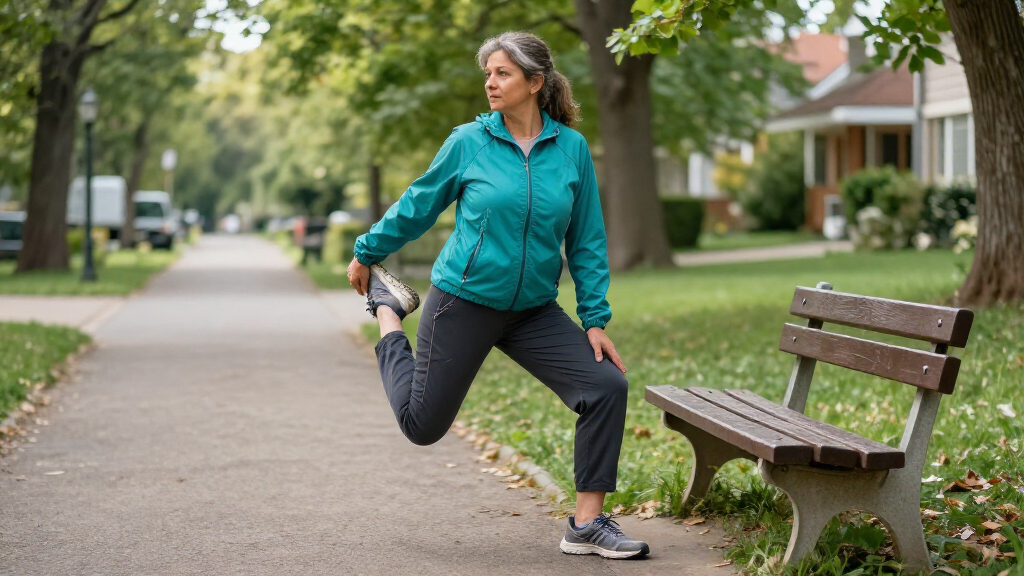
The routine includes a standing calf stretch, the moving cat-cow stretch, a supine figure-four stretch and a standing hamstring stretch. Tsai told Fit&Well that the movements target major areas used during walking, including the core, back, hips and glutes, hamstrings, and calves. The report presents the sequence as post-walk guidance, not as a treatment for an injury or a guarantee against stiffness.
For the three static stretches, Tsai recommends holding a comfortable position for 10 to 30 seconds. She says older adults may benefit from holding them for 30 to 60 seconds. Cat-cow is different: it involves slowly alternating between a rounded and gently arched back, coordinated with breathing, for about one minute. The source suggests trying the routine two or three times a week at first, then building toward daily stretching.
The instructions call for adjusting each movement to personal comfort. In the calf stretch, the heel stays on the floor while the person leans toward a wall; moving the heel closer makes the stretch more intense. For the figure-four, people can remain in the starting position if lifting the legs creates too strong a sensation. The hamstring stretch can be done near a wall or chair for balance, and the cat-cow movements should be slow.
A Short Routine After Longer Walks
Walking is accessible exercise, but longer sessions can leave some people feeling sore or stiff, the Fit&Well report says. The recommended routine offers readers a specific set of post-walk movements rather than a general instruction to stretch. It also distinguishes between static holds and cat-cow, which is performed as a slow, breathing-led sequence.
The practical value is in the adjustments and cautions as much as the stretch names. A person can reduce the intensity by changing position, use a stable surface for support, and avoid pushing into pain. Those details may make the exercises easier to adapt, but the report does not establish that the routine prevents injury or works equally well for everyone.
Popular right now

De'Longhi All-in-One Espresso and Coffee Maker with 10-Cup Pot and Milk Frother

TCL 75-Inch QM6K QLED Mini LED 4K HDR Smart Google TV, 144Hz

Dyson R3 Nurovi Spot+Scrub UV Robot Vacuum
As an affiliate, we earn on qualifying purchases.
Tsai’s Advice and Stretch Sequence
The source is a Fit&Well exercise report drawing on comments from Dr. Margaret Tsai, identified as a physical therapist with Sutter Health. Her advice is specifically framed around stretching after a hike or a longer walking session; the report notes that a short stroll is less likely to leave someone stiff or sore.
The four movements cover different areas. The standing calf stretch is done facing a wall, with one set of toes against it and the heel grounded. Cat-cow alternates spinal rounding and arching on hands and knees. The figure-four is performed lying down, crossing one ankle over the opposite knee and drawing the supporting leg toward the chest. For the standing hamstring stretch, one foot is placed forward with its heel down and toes lifted while the hips hinge back.
Tsai advises keeping the back neutral during the static stretches rather than rounding it. Cat-cow is the exception because rounding and arching the spine are part of the movement. The report also advises anyone with an injury or reservations about doing the exercises to consult a doctor before trying them.
“These stretches target the major muscle groups that are utilized [during walking], specifically the core, back, hip/glutes, hamstrings, and calves.”
— Dr. Margaret Tsai, physical therapist with Sutter Health, quoted by Fit&Well
Limits of the Available Guidance
The Fit&Well article provides expert recommendations, but the supplied source does not cite a study testing this exact four-stretch sequence or quantify how much it changes stiffness, mobility or injury risk. It also does not define how long a walk must be before someone is likely to feel sore, or establish that stretching is necessary after every walk.
The guidance may not suit every person, particularly someone with an injury, balance concerns or discomfort during a movement. The report advises checking with a doctor when injuries or reservations are present, but does not give individualized modifications or identify conditions for which a particular stretch should be avoided.
How to Try the Routine Safely
People who choose to try the sequence can begin with the shorter suggested holds and use only a comfortable range of motion. Tsai’s guidance is to build gradually, avoid pain and initially stretch two or three times weekly before considering a daily routine. Anyone who needs balance support can perform the hamstring stretch beside a solid surface.
The source does not announce a follow-up study or further guidance. For people with injuries or doubts about whether these movements are appropriate, the next step identified in the report is to consult a doctor before starting.
Key Questions
What four stretches does the report recommend after walking?
Fit&Well lists a standing calf stretch, cat-cow, figure-four stretch and standing hamstring stretch. The recommendations are attributed to physical therapist Dr. Margaret Tsai.
How long should each stretch be held?
Tsai suggests holding static stretches for 10 to 30 seconds. She says older adults may benefit from holds of 30 to 60 seconds. Cat-cow is performed as a slow alternating movement for about one minute.
Should the stretches hurt?
No. Tsai advises easing into the positions until there is comfortable tension, not pain. The report says to adjust or stay in an easier position if the stretch feels too strong.
How often does the report suggest stretching?
The source suggests starting with two or three sessions per week and gradually building toward daily stretching. It does not say that everyone needs to stretch after every walk.
What should someone do if they have an injury or balance concern?
The report advises checking with a doctor before trying the stretches if an injury or other concern is present. For balance support during the standing hamstring stretch, it recommends working near a wall or chair.
Source: fitandwell.com