
For most adults seeking structured, step-by-step support, The Anxiety Workbook: A 7-Week Plan is my best overall pick, while The Cognitive Behavioral Workbook for Anxiety stands out for a more skills-focused CBT approach. Readers who want shorter daily prompts may prefer No Worries, and teens have two distinct options tailored to their age group. The main tradeoff is between a guided plan that asks for regular practice and a flexible journal that is easier to pick up for a few minutes at a time. Focus also matters: a workbook for generalized worry, overthinking, ADHD, or teen stress may fit better than a broad anxiety guide. Read on for the full comparison and help choosing the right format for your needs.

Give the gift of listening to someone who needs a break
- Choose a 1-, 3-, 6- or 12-month membership
- They pick the audiobooks they love
- Easy to send by email
Key Takeaways
- Structured programs lead this roundup: The 7-week plans and step-by-step CBT workbooks offer a clearer practice path than open-ended journaling, but ask for more consistent effort.
- Specific concerns call for specific workbooks: The generalized anxiety guide targets worry and uncertainty, while the ADHD-and-anxiety title addresses focus alongside stress.
- Daily journals trade depth for ease: No Worries and the journal-workbook hybrids may feel more approachable for brief check-ins, though they may offer less of a staged learning path.
- Teen choices differ in breadth: The Complete Teen Mental Health Workbook covers ACT, CBT, and DBT, while Coping Skills Workbook for Teens focuses on anger, anxiety, and stress skills.
- More material is not automatically a better fit: The Anxiety and Phobia Workbook and the generalized anxiety guide suit readers seeking broad or specific coverage, while beginners may prefer a bounded plan.




| self-help workbooks for anxiety | Format | ASIN | Topics |
|---|---|---|---|
| The Anxiety Workbook: A 7-Week | Workbook | 1623159733 | — |
| The Adult ADHD and Anxiety Wor | Workbook | 1648482430 | ADHD and anxiety |
| Retrain Your Brain: Cognitive | Workbook | 1623157803 | Depression and anxiety |
| The Overthinking and Anxiety W | Workbook | B0H45T8X1D | Anxiety, overthinking, and confidence |
| No Worries: A Guided Journal t | Guided journal | 1952676002 | Anxiety and stress |
| Healing Anxiety and Overthinki | Journal and workbook | B0BNV86GX8 | Fear management and finding peace |
| The Cognitive Behavioral Workb | Workbook | 1626250154 | — |
| The Generalized Anxiety Disord | Workbook | 1626251517 | Uncertainty, worry, and fear |
| The Complete Teen Mental Healt | Workbook | B0GW8D8FFX | Anxiety, depression, and stress management |
| The Mind Reset Series: The Ove | Workbook | 9907018880 | — |
| For the Woman Who Can’t Quiet | Workbook | — | Anxiety, stress, and overthinking |
| Coping Skills Workbook for Tee | Workbook | — | Anger, anxiety, stress, and emotional regulation |
| The Anxiety and Phobia Workboo | Self-help workbook | — | Anxiety and phobias |
More Details on Our Top Picks
The Anxiety Workbook: A 7-Week Plan to Overcome Anxiety, Stop Worrying, and End Panic
The seven-week plan gives this workbook a clear place in the lineup: it suits readers who want a time-bound structure focused directly on anxiety, worry, and panic. Compared with Retrain Your Brain, which names CBT and also addresses depression, this title keeps its stated focus narrower and more directly centered on anxiety symptoms. That can make the choice simpler for someone whose main concern is worry or panic rather than a broader mood workbook.
The tradeoff is limited detail in the available product information: specific exercises and techniques aren’t identified, so I can’t tell how much guidance each week provides. Readers who prefer a daily journal format may find No Worries a better fit, while this one makes more sense for someone willing to follow a multiweek plan. It is a self-help workbook, not a substitute for professional care when symptoms need clinical support.
Pros:- Provides a defined seven-week structure
- Names anxiety, worry, and panic as its focus
- Offers a more time-bound plan than the daily-practice framing of No Worries
Cons:- Available product details do not describe the exercises or therapeutic techniques
- The seven-week format may feel too scheduled for readers who prefer open-ended practice
- The supplied information does not clarify how the plan handles different anxiety concerns
Best for: Readers seeking a time-bound, seven-week workbook centered on anxiety, worrying, and panic.
Not ideal for: Readers who need a clearly described CBT method, detailed exercise previews, or a flexible daily journal format.
- Format:Workbook
- Program length:7 weeks
- Primary topic:Anxiety
- Additional topics:Worrying and panic
- Stated plan:Structured seven-week plan
- ASIN:1623159733
Our verdict“Choose this workbook if you want a seven-week plan aimed specifically at anxiety, worry, and panic and can accept limited detail about its exercises.”
The Adult ADHD and Anxiety Workbook: Cognitive Behavioral Therapy Skills to Manage Stress, Find Focus, and Reclaim Your Life
The combined ADHD-and-anxiety focus sets this workbook apart from anxiety-only choices such as The Anxiety Workbook. Its title points to CBT skills aimed at stress management and focus as well as anxiety, making it a more specific match for adults dealing with overlapping concerns rather than readers seeking a general anxiety plan. That emphasis may help buyers looking for one workbook framed around both attention and anxiety.
The tradeoff is that the supplied product information gives no details about the structure, exercises, or program length. Compared with Retrain Your Brain, whose seven-week CBT format and anxiety-and-depression scope are stated, it is harder to judge how the skills are organized or how much guided practice to expect. I would pick this for the dual-topic focus, not on the assumption that it offers a particular schedule or depth of treatment. A workbook cannot replace individualized clinical support.
Pros:- Addresses adult ADHD and anxiety together
- Explicitly identifies cognitive behavioral therapy skills
- Connects its stated aims to stress management and focus
Cons:- The supplied information does not describe specific exercises
- No program length or format details are provided
- Its dual focus may be less relevant to readers seeking anxiety-only guidance
Best for: Adults who want self-help material explicitly framed around both ADHD-related focus concerns and anxiety management.
Not ideal for: Readers without ADHD concerns or buyers who want a clearly stated program length and detailed exercise information before choosing.
- Audience:Adults
- Topics:ADHD and anxiety
- Approach named in title:Cognitive behavioral therapy (CBT) skills
- Stated aims:Manage stress, find focus, and reclaim your life
- Program length:Not specified in provided product data
- Format:Workbook
- ASIN:1648482430
Our verdict“Choose this if you want a workbook explicitly linking adult ADHD, anxiety, stress, and focus; skip it if you need a clearly outlined schedule.”
Retrain Your Brain: Cognitive Behavioral Therapy in 7 Weeks
Named CBT techniques give this workbook a more explicit method than The Anxiety Workbook, whose description supplies a seven-week plan but no specific therapeutic approach. That distinction matters if you want to practice a recognizable framework rather than choose a workbook based only on its schedule. Its seven-week format also gives readers a defined period for working through skills, while its coverage of both anxiety and depression may suit people whose concerns overlap.
That wider scope is also the tradeoff: readers looking only for anxiety and panic may prefer the more narrowly framed The Anxiety Workbook. The available information does not detail the individual exercises, so I can’t judge how much instruction or customization the program offers. This is best treated as a structured CBT self-help option, not as a replacement for mental health care when symptoms call for professional support.
Pros:- Clearly names cognitive behavioral therapy as its approach
- Uses a defined seven-week format
- Addresses both anxiety and depression
Cons:- The broader depression-and-anxiety scope may not suit readers focused only on anxiety
- Available details do not identify specific CBT exercises
- The fixed program length may not suit readers wanting an open-ended journal
Best for: Readers who want a seven-week workbook that explicitly uses CBT and includes both anxiety and depression.
Not ideal for: People seeking an anxiety-only workbook or detailed information about exercises before committing to a structured program.
- Format:Workbook
- Approach:Cognitive behavioral therapy (CBT)
- Program length:7 weeks
- Topics:Depression and anxiety
- Stated purpose:Practice CBT techniques for managing depression and anxiety
- ASIN:1623157803
Our verdict“Pick this for a time-bound CBT approach covering anxiety and depression, especially if you value a stated method over a narrowly anxiety-only focus.”
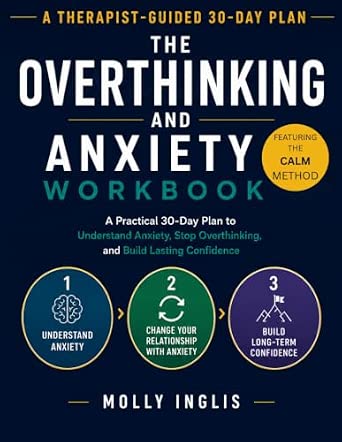
The Overthinking and Anxiety Workbook: A Practical 30-Day Plan to Understand Anxiety, Stop Overthinking, and Build Lasting Confidence
A 30-day plan centered on overthinking distinguishes this workbook from the seven-week schedules in The Anxiety Workbook and Retrain Your Brain. It is the clearest fit here for readers who connect their anxiety with repetitive thoughts and want a shorter calendar-based program that also names confidence as a goal. The focus is more specific than a broad anxiety workbook, which may make it easier to decide whether the subject matches your needs.
The shorter schedule does not tell me how demanding the daily work is, and the available details name no specific exercises or therapeutic approach. By comparison, Retrain Your Brain at least identifies CBT, while this title’s selling point is its topic and timeframe. Readers who want a proven-to-them method spelled out should look elsewhere; those seeking a 30-day structure may find the outline appealing. It remains self-help material, not a replacement for tailored clinical care.
Pros:- Sets out a defined 30-day plan
- Directly names overthinking alongside anxiety
- Includes confidence-building among its stated aims
Cons:- The available description does not identify specific exercises or techniques
- No therapeutic approach is stated in the supplied product data
- A 30-day schedule may not suit readers who prefer a longer or flexible pace
Best for: Readers who want a 30-day workbook specifically addressing overthinking, anxiety, and confidence.
Not ideal for: Buyers who need a named therapeutic method, a preview of exercises, or a longer program with a stated CBT framework.
- Format:Workbook
- Program length:30 days
- Topics:Anxiety, overthinking, and confidence
- Stated plan:Practical 30-day plan
- Stated aims:Understand anxiety, stop overthinking, and build confidence
- ASIN:B0H45T8X1D
Our verdict“Choose this for a short, overthinking-centered plan; choose Retrain Your Brain instead if a named CBT approach matters more than a 30-day schedule.”
No Worries: A Guided Journal to Help You Calm Anxiety, Relieve Stress, and Practice Positive Thinking Each Day
Daily guided journaling makes No Worries the most practice-oriented, less program-driven choice in this group. Its focus on anxiety, stress relief, and positive thinking gives readers a recurring reflection habit, unlike The Anxiety Workbook and Retrain Your Brain, which are presented as seven-week plans. That may suit someone who wants to check in regularly without signing up for a fixed multiweek sequence.
The tradeoff is limited detail about the journal’s prompts, layout, or guidance, so I can’t tell how structured that daily practice feels. Readers who want a named therapeutic method may prefer Retrain Your Brain, which explicitly identifies CBT; readers looking for a step-by-step anxiety program may prefer either seven-week workbook. No Worries is best understood as a daily reflection option, not as evidence that positive thinking alone will address every form of anxiety.
Pros:- Frames the product as a guided journal for daily practice
- Addresses anxiety and stress together
- Includes positive thinking as a recurring focus
Cons:- The supplied information does not describe the journal prompts or layout
- No program length or therapeutic method is specified
- May feel less step-by-step than the structured plans in The Anxiety Workbook and Retrain Your Brain
Best for: Readers who prefer a daily guided journal for reflecting on anxiety, stress, and positive thinking over a fixed multiweek workbook.
Not ideal for: People who want a clearly stated CBT method, a defined program length, or detailed information about the journal’s prompts.
- Format:Guided journal
- Practice frequency stated:Daily
- Topics:Anxiety and stress
- Additional focus:Positive thinking
- Program length:Not specified in provided product data
- ASIN:1952676002
Our verdict“Choose No Worries if you want daily guided reflection; choose a structured workbook instead if you need a defined schedule or named CBT skills.”
Healing Anxiety and Overthinking Journal and Workbook
Pairing reflection with workbook activities gives this option a different feel from program-led choices such as The Cognitive Behavioral Workbook for Anxiety: A Step-By-Step Program. Its stated focus on anxiety, overthinking, fear, and finding peace may suit readers who want space to write as well as complete structured prompts. That mix can help someone notice recurring worries rather than only read about coping ideas. The tradeoff is that the available details do not identify a specific therapy method, session plan, or intended audience, so it is harder to judge how systematic the exercises are. Compared with The Generalized Anxiety Disorder Workbook, which names CBT and targets GAD, this journal-workbook appears broader but less clearly defined. I’d choose it for reflective practice, not as a substitute for tailored clinical support.
Pros:- Combines journaling with workbook activities
- Directly addresses anxiety and overthinking
- Includes a focus on managing fear
- Frames the work around finding greater peace
Cons:- The available description does not identify a specific therapeutic approach
- No session plan or exercise sequence is provided in the supplied details
- The intended audience and level of guidance are not specified
Best for: Adults who want anxiety and overthinking prompts combined with room for personal reflection and journaling
Not ideal for: Readers seeking a clearly sequenced CBT program or a workbook specifically tailored to generalized anxiety disorder
- Format:Journal and workbook
- Primary focus:Anxiety and overthinking
- Topics:Fear management and finding peace
- ASIN:B0BNV86GX8
- Stated method:Not specified in the supplied product details
- Intended audience:Not specified in the supplied product details
Our verdict“Choose this if writing through worries is as appealing to you as completing exercises, but opt for a named CBT program if you want a clearer method.”
The Cognitive Behavioral Workbook for Anxiety: A Step-By-Step Program
A step-by-step CBT program makes this the clearest fit for readers who want a defined sequence rather than a primarily reflective journal. Its title signals a structured approach to anxiety, while Healing Anxiety and Overthinking Journal and Workbook combines writing with activities but does not specify a therapy model or sequence in the supplied details. That distinction matters if you want to follow a recognizable framework and work through material in order. The limitation here is that the product information provided is sparse: it does not confirm the workbook’s audience, specific topics, or exercise format beyond the program framing. Compared with The Generalized Anxiety Disorder Workbook, this option sounds broader, while that book specifically addresses uncertainty, worry, and fear in GAD. I’d favor this for structure, but check the full contents if you need a particular focus.
Pros:- Explicitly framed around cognitive behavioral therapy
- Step-by-step program structure may help readers work through material in order
- Focused on anxiety rather than broad mental wellness topics
Cons:- The supplied product details do not describe particular exercises or topics
- The intended audience is not specified in the supplied details
- The program length and level of support are not stated
Best for: Readers who want an anxiety workbook framed as a step-by-step cognitive behavioral therapy program
Not ideal for: People looking for a specifically teen-focused workbook, a journaling-first format, or confirmed GAD-specific material
- Format:Workbook
- Approach:Cognitive behavioral therapy (CBT)
- Program structure:Step-by-step program
- Primary focus:Anxiety
- Publisher:Not specified in the supplied product details
- Intended audience:Not specified in the supplied product details
- ASIN:1626250154
Our verdict“Pick this when a structured CBT path is your priority, and compare its full contents with the more specifically GAD-focused workbook if worry and uncertainty are your main concerns.”
The Generalized Anxiety Disorder Workbook: A Comprehensive CBT Guide for Coping with Uncertainty, Worry, and Fear
Specificity is its main advantage: this workbook is explicitly aimed at generalized anxiety disorder and names uncertainty, worry, and fear as its targets. Its CBT approach gives readers a defined framework, unlike Healing Anxiety and Overthinking Journal and Workbook, whose supplied details do not identify a therapy method. Compared with the broader The Cognitive Behavioral Workbook for Anxiety: A Step-By-Step Program, this is the more targeted choice when persistent worry and uncertainty are central concerns. That focus is also its boundary; readers seeking teen-specific guidance, a journaling-first experience, or coverage of anxiety in a wider range of situations may prefer another option. The supplied information does not spell out individual exercises or pacing, so I would check the contents if you need a particular format. It makes most sense for adults seeking a focused CBT self-help resource.
Pros:- Specifically focuses on generalized anxiety disorder
- Uses a cognitive behavioral therapy approach
- Directly addresses uncertainty, worry, and fear
- Identified as part of the New Harbinger Self-Help Workbooks series
Cons:- Its GAD focus may be narrower than a general anxiety workbook
- The supplied details do not specify exercise types or pacing
- The intended audience is not explicitly stated in the supplied details
Best for: Adults whose main concerns are persistent worry, fear, and difficulty tolerating uncertainty associated with generalized anxiety
Not ideal for: Teens, readers seeking a broad anxiety overview, or people who want a journaling-centered workbook rather than a named CBT approach
- Format:Workbook
- Approach:Cognitive behavioral therapy (CBT)
- Primary focus:Generalized anxiety disorder
- Topics:Uncertainty, worry, and fear
- Publisher series:New Harbinger Self-Help Workbooks
- Intended audience:Not specified in the supplied product details
- ASIN:1626251517
Our verdict“Choose this over a broader anxiety workbook if GAD-related worry and uncertainty are your main concerns and a CBT framework fits your needs.”
The Complete Teen Mental Health Workbook: ACT, CBT & DBT Skills to Reduce Anxiety and Depression, Manage Stress, and Build Emotional Resilience
Teen-specific guidance is the clearest reason to choose this workbook over adult-oriented options such as The Cognitive Behavioral Workbook for Anxiety: A Step-By-Step Program. It brings together ACT, CBT, and DBT skills and covers anxiety alongside depression, stress, and emotional resilience. That breadth may help a teen who wants coping tools for several connected challenges rather than a workbook centered only on anxiety. The tradeoff is that anxiety is one part of a wider mental health scope, so readers seeking focused work on generalized worry may get a closer match from The Generalized Anxiety Disorder Workbook. The supplied details also do not describe the exercises or how the three approaches are organized. I’d choose this for a teen who wants varied skills, while involving a trusted adult or clinician when extra support is needed.
Pros:- Designed for a teen audience
- Includes ACT, CBT, and DBT skills
- Addresses anxiety, depression, and stress
- Includes emotional resilience as a goal
Cons:- Its broad mental health scope gives anxiety less exclusive attention
- The supplied details do not explain how the three approaches are organized
- Specific exercises and pacing are not described in the supplied details
Best for: Teens who want practical skills addressing anxiety alongside stress, low mood, and emotional resilience
Not ideal for: Adults seeking an anxiety-only workbook or readers who prefer a single, clearly specified therapeutic approach
- Format:Workbook
- Audience:Teens
- Approaches:ACT, CBT, and DBT
- Topics:Anxiety, depression, and stress management
- Additional focus:Emotional resilience
- ASIN:B0GW8D8FFX
Our verdict“Choose this for a teen who wants a broad toolkit for anxiety and related stress, but select a focused CBT workbook for a narrower anxiety plan.”
The Mind Reset Series: The Overthinking & Anxiety Workbook
Overthinking is named alongside anxiety, giving this workbook a more specific stated focus than a general anxiety guide. That could suit readers whose main frustration is getting caught in repetitive thoughts. Compared with The Generalized Anxiety Disorder Workbook, which identifies CBT and targets uncertainty, worry, and fear, this option’s supplied details do not establish a therapeutic approach or explain how the workbook addresses overthinking. It is also less clearly defined than The Cognitive Behavioral Workbook for Anxiety: A Step-By-Step Program, whose title promises a structured CBT sequence. The limited description makes it difficult to judge the exercise style, intended audience, or progression. I’d shortlist it for its direct topic match, but verify the contents if you need a particular method or a guided plan.
Pros:- Names both overthinking and anxiety as its focus
- Workbook format suggests an activity-oriented resource
- May be a closer topic match than a general mental health workbook for repetitive thinking
Cons:- The supplied description provides no details about its therapeutic approach
- No exercises, pacing, or program structure are specified
- The intended audience is not stated in the supplied details
Best for: Readers who specifically want a workbook about overthinking and anxiety and are comfortable checking the contents for method and structure
Not ideal for: People who need a confirmed CBT framework, a step-by-step schedule, or clearly stated audience and exercise details
- Series:The Mind Reset Series
- Format:Workbook
- Primary topics:Overthinking and anxiety
- Approach:Not specified in the supplied product details
- Program structure:Not specified in the supplied product details
- Intended audience:Not specified in the supplied product details
- ASIN:9907018880
Our verdict“Consider this if overthinking is your main concern, but favor a named CBT workbook if you want a clearly described method and sequence.”
This workbook’s clearest distinction is its focus on women dealing with anxiety, stress, and overthinking, paired with a supportive presentation. That may feel more personally directed than The Anxiety Workbook: A 7-Week Plan to Overcome Anxiety, Stop Worrying, and End Panic, whose title signals a defined program and focus on panic. Here, the appeal is the stated audience and emotional tone rather than a specified method or schedule.
That limited detail is also the main drawback: the available information does not describe its exercises, structure, or therapeutic approach, so I can’t tell whether it offers guided practice or mostly general encouragement. Choose it if audience fit and a gentle framing matter more than a clearly mapped plan. Readers who want to know exactly what skills they will practice may prefer a workbook with named approaches or a stated program.
Pros:- Addresses anxiety, stress, and overthinking together.
- Designed specifically for women.
- Described as a supportive resource.
- Its audience focus gives it a distinct angle beside general anxiety workbooks.
Cons:- The available product information does not describe its exercises or activities.
- No therapeutic approach or workbook structure is specified.
- The broad topic range makes it difficult to judge how deeply it treats any one concern.
Best for: Women looking for a supportive anxiety workbook that also addresses stress and overthinking, and who do not require a documented method before choosing.
Not ideal for: Readers who want a structured CBT or DBT program, a stated timeline, or clear details about exercises before buying.
- Format:Workbook
- Audience:Women
- Topics:Anxiety, stress, and overthinking
- Approach:Described as supportive; specific method not provided
- Exercises:Details not provided
- Structure:Details not provided
Our verdict“Choose this if a women-focused, supportive framing matters more to you than a clearly specified method or step-by-step plan.”
Coping Skills Workbook for Teens: How to Manage Anger, Anxiety, and Stress with CBT and DBT Exercises
For teen readers, the strongest reason to choose this workbook is its combination of age-specific focus and named CBT and DBT exercises. It covers anxiety alongside anger and stress, so its emphasis is broader emotional regulation rather than anxiety alone. Compared with The Complete Teen Mental Health Workbook: ACT, CBT & DBT Skills to Reduce Anxiety and Depression, Manage Stress, and Build Emotional Resilience, this title names anger as a central concern and does not claim to cover depression or ACT.
That narrower description can help families looking for skills around anger, anxiety, and stress, but the available details do not say how the exercises are organized or how much support adults may need to provide. It is a more clearly method-led choice than For the Woman Who Can’t Quiet Her Mind, though it is not aimed at adult buyers. Teens seeking a workbook only about anxiety may find its wider emotional focus less targeted.
Pros:- Written specifically for teens.
- Names both CBT and DBT exercises.
- Addresses anger, anxiety, and stress rather than treating anxiety in isolation.
- Focuses on emotional regulation skills.
Cons:- The available information does not describe the exercise sequence or workbook length.
- Its focus on several emotional challenges may feel less targeted for readers dealing only with anxiety.
- No details are provided about adult guidance or support.
Best for: Teens who want practical CBT- and DBT-based exercises to work on anxiety alongside anger, stress, and emotional regulation.
Not ideal for: Adults seeking a self-help workbook for their own anxiety, or teens who want an anxiety-only guide with a detailed structure described in advance.
- Format:Workbook
- Audience:Teens
- Topics:Anger, anxiety, stress, and emotional regulation
- Approaches:CBT and DBT exercises
- Exercise focus:Coping skills and emotional regulation
- Structure:Details not provided
Our verdict“Pick this for a teen who wants CBT- and DBT-based coping practice across anxiety, anger, and stress rather than an anxiety-only workbook.”
The Anxiety and Phobia Workbook
This title stands apart through its explicit pairing of anxiety and phobias. That makes it the most relevant of these three for readers who want to address fear or phobia concerns alongside anxiety, rather than focus on teen emotional regulation or a women-centered supportive tone. It is part of the New Harbinger Self-Help Workbooks series, which identifies it as a workbook, but the provided product information gives no further detail about its methods, exercises, or organization.
Compared with Coping Skills Workbook for Teens, it is not described as age-specific or as using named CBT and DBT exercises; compared with For the Woman Who Can’t Quiet Her Mind, it names phobias but does not specify an intended audience beyond its subject matter. The title gives a useful topic signal, but not enough to judge how structured or accessible the material is. Readers who need a known approach or clear program outline may want a more detailed listing.
Pros:- Explicitly covers both anxiety and phobias.
- Identified as part of a self-help workbook series.
- Its topic focus distinguishes it from workbooks centered on broader emotional regulation.
- May suit readers looking for a general self-help workbook rather than a specified audience.
Cons:- No details are provided about exercises or therapeutic approaches.
- The available information does not specify the intended age group or reader level.
- No schedule, length, or program structure is described.
Best for: Readers seeking a workbook explicitly covering anxiety and phobias who are comfortable choosing without details about the exercises or therapeutic method.
Not ideal for: Buyers who need a teen-specific resource, a women-focused tone, or confirmed CBT exercises and a stated step-by-step structure.
- Format:Self-help workbook
- Series:New Harbinger Self-Help Workbooks
- Topics:Anxiety and phobias
- Audience:Not specified
- Approach:Not specified
- Exercises:Details not provided
Our verdict“Choose this if phobias are part of what you want to address, but seek a more fully described option if you need a known method or clear program structure.”

How We Picked
I compared the 13 titles by how clearly they match common anxiety-related needs, including general worry, overthinking, uncertainty, stress, ADHD-related focus challenges, and teen concerns. I also weighed how each format may work in daily life: a fixed-length plan can make progress easier to organize, while a journal may be simpler to use in short sessions. The titles were judged by the scope signaled in their names and descriptions, the skills or approaches they identify, and how specifically they speak to a reader’s situation.
The order favors books with a clear anxiety focus and a defined path through the material, then makes room for specialized, teen-focused, and journaling options whose value depends more on the reader’s needs. A broad title is not automatically ranked above a focused one; it rises when its scope suits more buyers, while narrower books can be the better match for a particular concern. Since the list is based on the provided product information rather than claims of hands-on testing, I avoid treating titles or named methods as proof of clinical effectiveness.
| self-help workbooks for anxiety | Format |
|---|---|
| The Anxiety Workbook: A 7-Week | Workbook |
| The Adult ADHD and Anxiety Wor | Workbook |
| Retrain Your Brain: Cognitive | Workbook |
| The Overthinking and Anxiety W | Workbook |
| No Worries: A Guided Journal t | Guided journal |
| Healing Anxiety and Overthinki | Journal and workbook |
| The Cognitive Behavioral Workb | Workbook |
| The Generalized Anxiety Disord | Workbook |
| The Complete Teen Mental Healt | Workbook |
| The Mind Reset Series: The Ove | Workbook |
| For the Woman Who Can’t Quiet | Workbook |
| Coping Skills Workbook for Tee | Workbook |
| The Anxiety and Phobia Workboo | Self-help workbook |
Factors to Consider When Choosing Self-help Workbooks For Anxiety
Choosing an anxiety workbook is less about finding the longest list of exercises and more about picking a format and focus you can realistically use. I would start with what you want help with, then check how the book expects you to work through it.
Match the workbook to the concern you want to address
Anxiety can show up as persistent worry, panic, overthinking, stress, or difficulty focusing, and a broad workbook may not address each one in equal detail. Start by naming the pattern you most want to work on rather than choosing a book simply because its title promises many benefits. Specialized books can give more space to a defined concern, but may leave other needs outside their scope. A general anxiety title offers wider coverage, though its exercises may feel less tailored. If several concerns overlap, look for a workbook that acknowledges that mix instead of assuming one issue explains everything.
Choose a pace you can keep up with
A week-by-week or month-long plan can reduce the burden of deciding what to do next, but a schedule is only helpful if its pace fits your routine. A guided journal may be easier to use on unpredictable days because it can support short, individual check-ins. Do not treat an unfinished chapter as a personal failure; real life may require pausing or repeating an exercise. Before choosing, ask whether you prefer a sequence with milestones or a flexible set of prompts. The tradeoff is structure versus freedom, not discipline versus success.
Check how much practice the format asks of you
Some workbooks are designed around reflection, while others present themselves as skills programs with exercises and repeated practice. Consider whether writing, tracking patterns, and returning to earlier notes feel useful or burdensome to you. A workbook that looks thorough can become hard to use if every session requires more time or concentration than you can spare. If you are new to self-guided work, a clear starting point and manageable exercises may matter more than a wide range of techniques. A lighter journal can be a sensible entry point, even if it does not provide the same depth as a structured program.
Treat named therapy approaches as a guide, not a guarantee
Titles in this roundup name CBT, ACT, or DBT skills, which can help you identify the approach a book says it uses. Those labels do not by themselves tell you whether the explanations, exercises, or tone will suit you. Look for a book that describes practical activities clearly and uses language you can follow without extra context. If you already work with a mental health professional, you can ask whether a self-help workbook fits alongside your existing support. A workbook is a tool for independent practice, not a substitute for individualized care when you need it.
Account for age, identity, and overlapping needs
Age-specific language can make examples and exercises feel more relevant, particularly for teens, but a teen workbook may not match an adult’s needs or reading preferences. A title written for women or for people with ADHD may feel more personally relevant to some readers, yet the fit depends on the actual concern and preferred tone. If you are buying for someone else, avoid assuming that a label alone makes the book a good match. Consider whether the recipient wants a workbook, a journal, or a more focused skills guide. A book is more likely to be used when its voice and scope feel respectful rather than prescriptive.
Frequently Asked Questions
Should I choose a structured program or a guided journal?
Choose a structured program if you want a sequence of topics and a clear sense of what to work on next. A guided journal can suit you better if short, flexible check-ins feel easier to sustain than longer exercises. The tradeoff is that a sequence may offer more direction, while a journal may be less demanding to pick up on a busy day. Think about how you actually make time for reflection, not how much time you hope to have. Either format can be a poor fit if its workload or tone puts you off using it.
Can a general anxiety workbook help with panic or phobias?
A general anxiety workbook may provide broad exercises, but its title alone cannot tell you how much attention it gives to panic or phobias. If either concern is your main reason for buying, compare the book’s stated scope with that specific need rather than assuming all anxiety workbooks cover it equally. A broader guide may be useful when your concerns vary, while a more focused resource may make the subject easier to locate and work through. Check the contents or sample pages when available before deciding. Seek professional guidance if symptoms are severe, worsening, or interfering with daily life.
Is a teen workbook appropriate for an adult who wants simpler exercises?
It might be, but the age range can shape the examples, wording, and situations used throughout the book. An adult may find the exercises accessible yet feel that the scenarios do not reflect adult responsibilities or relationships. Compare the workbook’s stated approaches and topics with what you want to practice, rather than choosing by simplicity alone. If the recipient is a teen, also consider whether they want to use a workbook independently or with support from a trusted adult. The best match is one whose language feels comfortable and whose exercises make sense for the reader’s life.
What should I do if I stop using a workbook partway through?
First, check whether the format or workload is the problem: you may need shorter sessions, a different pace, or a more flexible journal. You do not have to restart from the beginning if one section still feels useful; returning to a relevant exercise can be a reasonable way to continue. A workbook should support practice, not become another source of pressure. If the material feels upsetting or hard to manage alone, pause and consider discussing it with a qualified professional. Repeated difficulty using a book may mean it is the wrong format for you, not a personal shortcoming.
When should I use professional support instead of relying on a workbook?
A workbook is designed for self-guided practice and cannot assess your situation or tailor care to you. Consider professional support if anxiety is intense, lasts over time, interferes with work or relationships, or makes daily tasks difficult. It can also help to speak with a clinician if exercises raise distress that you do not feel able to manage alone. You may still use a workbook alongside professional care if it fits your plan and your clinician agrees. For an immediate safety concern, contact local emergency services or a crisis support service.
Conclusion
My best overall recommendation is The Anxiety Workbook: A 7-Week Plan for readers who want a defined route through general anxiety work. For best value in practical focus, I would shortlist Retrain Your Brain: Cognitive Behavioral Therapy in 7 Weeks, while readers who want a more extensive anxiety-and-phobia reference may prefer The Anxiety and Phobia Workbook as the best premium-style choice—though the supplied information does not establish a price tier. Beginners who want brief, low-pressure prompts can start with No Worries. For specific needs, choose The Adult ADHD and Anxiety Workbook for overlapping focus challenges, The Generalized Anxiety Disorder Workbook for worry and uncertainty, or one of the two teen titles according to whether broader emotional-health skills or focused coping exercises matter more. Pick the format you are most likely to return to, and seek professional support when self-guided work is not enough.