Cross-comparing MBTI, Big Five, Enneagram, and DISC helps you understand different aspects of personality, behavior, and temperament. For example, extraversion in the Big Five aligns with MBTI’s Extraversion preference and DISC’s Influence style. While MBTI focuses on cognitive preferences, the Big Five offers a nuanced trait spectrum, and the Enneagram explores core motivations. Exploring their overlaps and differences reveals a fuller picture of how you interact and grow. Keep exploring to uncover how these models complement each other.
Key Takeaways
- MBTI focuses on cognitive preferences, while Big Five measures personality traits on a spectrum, offering complementary insights.
- Enneagram reveals core emotional motivations, contrasting with the behavioral and trait-based focuses of DISC and Big Five.
- Overlaps include extraversion (Big Five), influence style (DISC), and extraversion/introversion (MBTI), highlighting temperament similarities.
- Each tool emphasizes different aspects: MBTI on cognition, Big Five on traits, Enneagram on core fears, DISC on behavior.
- Combining these models provides a comprehensive understanding of personality, behavior, motivations, and interaction styles.
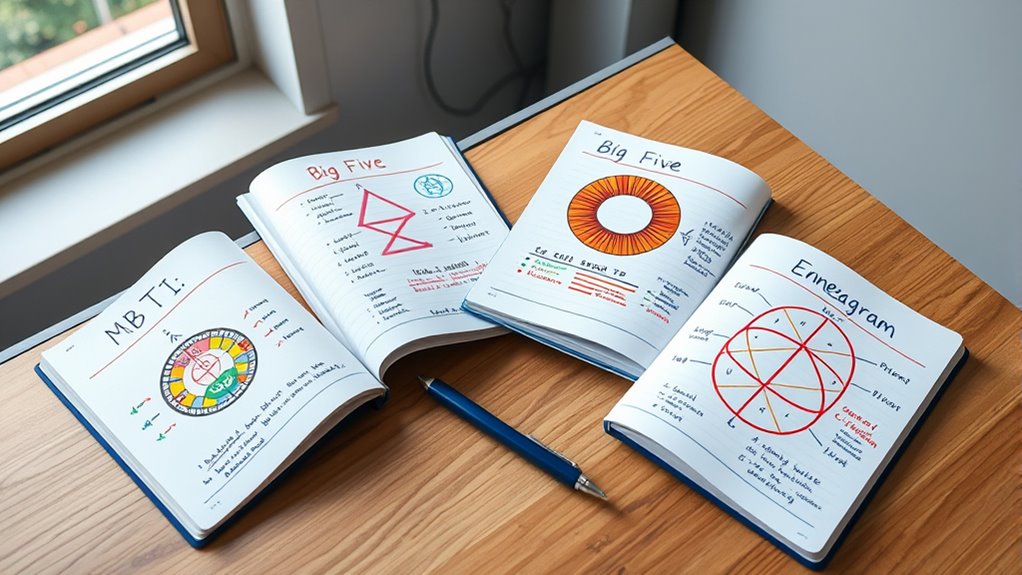
Understanding personality assessments can be overwhelming, especially when each system offers different insights into your behavior and preferences. When you explore tools like the MBTI, Big Five, Enneagram, or DISC, you’re examining unique lenses that reveal various aspects of your personality. These tools help you understand temperament differences—how you naturally respond to situations, interact with others, and process emotions. Recognizing these differences is vital because it shows you that personality isn’t one-size-fits-all; instead, it’s a spectrum shaped by innate tendencies and life experiences.
Understanding personality tools reveals how innate tendencies shape your responses and interactions.
The MBTI, for instance, categorizes you into one of 16 personality types based on preferences in four dichotomies: introversion vs. extraversion, sensing vs. intuition, thinking vs. feeling, and judging vs. perceiving. It emphasizes how you prefer to gather information and make decisions, giving you a clear picture of your personality style. In contrast, the Big Five assesses five broad traits—openness, conscientiousness, extraversion, agreeableness, and neuroticism—providing a more nuanced, continuous measure of personality. This system captures the spectrum of temperament differences, showing you where you fall on each trait and highlighting areas for growth or self-awareness.
The Enneagram takes a different approach by identifying nine core personality types, each driven by specific fears, desires, and motivations. It digs into the emotional and psychological core of your personality, offering insights into your habitual patterns and how you respond under stress or in growth. Meanwhile, the DISC focuses on four behavioral styles—Dominance, Influence, Steadiness, and Conscientiousness—highlighting your preferred way of communicating and working with others. This model is particularly useful for understanding your interaction style and how you navigate social environments.
When you compare these assessments, you’ll notice overlaps—like how extraversion in the Big Five aligns with the Extraversion preference in MBTI or the Influence style in DISC. Yet, you’ll also see differences, especially in how they interpret temperament differences. The MBTI emphasizes cognitive preferences, while the Big Five offers a broader trait-based perspective. The Enneagram explores deeper emotional drivers, and DISC focuses on observable behaviors. Understanding these distinctions allows you to appreciate the richness of personality assessments. They complement each other, giving you a fuller picture of who you are, how you relate to others, and where your natural temperament differences lie. Recognizing how different models highlight core personality traits can deepen your self-awareness and support your personal and professional growth.

The Psychologist's Book of Personality Tests: 24 Revealing Tests to Identify and Overcome Your Personal Barriers to a Better Life
As an affiliate, we earn on qualifying purchases.
Frequently Asked Questions
How Do Personality Tests Impact Workplace Hiring Decisions?
Personality tests influence your workplace hiring decisions by providing insights into a candidate’s personality precision, helping you identify the best fit. However, you should be cautious of hiring bias, as relying solely on these tests might overlook skills or experience. Use them as one tool among many to ensure fair, well-rounded evaluations, improving your chances of selecting candidates who align with your team’s needs.
Can Personality Types Change Over Time or Remain Fixed?
Personality types can change over time, but typically, personality stability remains fairly consistent. You might experience developmental changes as you grow, learn, and face new challenges, which can influence certain traits. However, core aspects often stay stable, especially in adulthood. So, while your personality can evolve with life experiences, fundamental traits tend to be resilient, making your overall personality relatively fixed over the long term.
Which Assessment Is Most Scientifically Validated for Personality?
While no assessment is perfect, the Big Five stands out as the most scientifically validated for personality. Its foundation in extensive research offers greater assessment accuracy and reliable personality validation. You can trust that the Big Five provides a nuanced view of traits, making it a solid choice for understanding yourself and others. Keep in mind, though, that all tools have their limits, and growth is always possible.
How Do Cultural Differences Influence Personality Test Results?
Cultural differences can considerably influence your personality test results by introducing cultural bias, which may skew how you respond. Tests often reflect the cultural context they were developed in, so without proper test adaptation, your results might not accurately represent your true personality. To get a fair assessment, it’s essential that personality tests are culturally adapted, minimizing bias and ensuring they resonate with diverse backgrounds.
Are There Privacy Concerns With Sharing Personality Test Data?
Did you know that over 60% of people worry about data privacy when sharing personality test results? Yes, sharing this info raises confidentiality concerns, especially if sensitive details are involved. You should be cautious because data privacy issues can lead to misuse or identity theft. Always check how your data is stored and who has access, ensuring your personal information remains protected and confidential.
Conclusion
By exploring MBTI, Big Five, Enneagram, and DISC, you gain a richer understanding of yourself. Did you know that 60% of people find their personality type aligns with multiple systems? Recognizing these overlaps can boost your self-awareness and improve your relationships. Embrace the complexity, and remember, no single test defines you—your unique blend of traits makes you truly one of a kind.