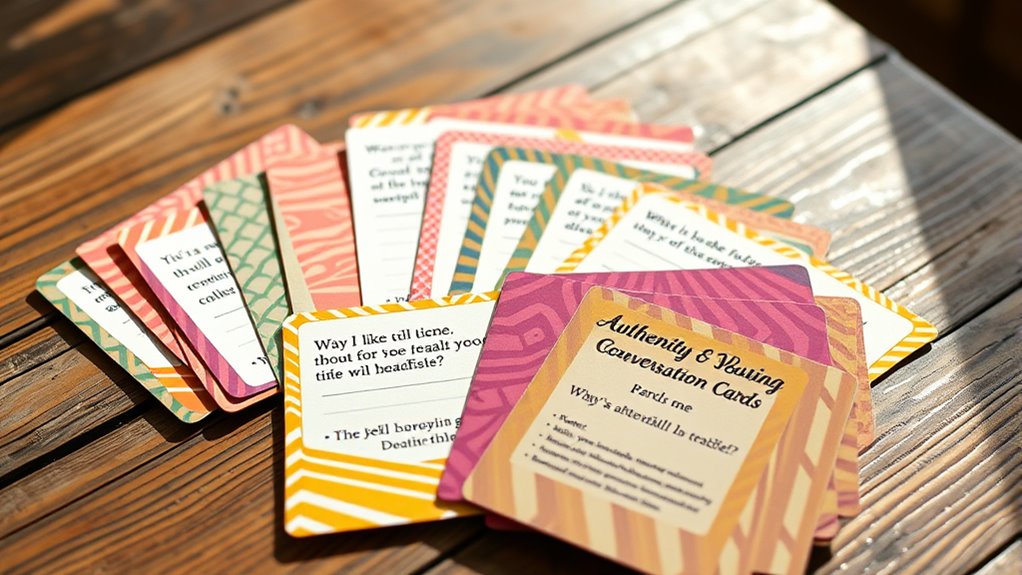

Authenticity conversation cards can help people move past small talk, but the right deck depends on who is playing and how much personal sharing feels comfortable. I’d choose BestSelf Deeper Talk Deck as the best overall pick for its focused promise of deeper conversation, while TableTopics Original stands out for approachable, general-purpose questions and {THE AND} Couples Edition for partners seeking a relationship-centered exchange. The main tradeoff is between broad, easy-to-use prompts and narrower decks designed for intimacy, family life, or workplace conversations. I also weigh how readily a deck can fit different groups, since a question that feels welcome among close friends may feel too personal at a team gathering. Read on for the full comparison and help matching a deck to your conversation style.

Turn your wind-down time into listening time
- Thousands of audiobooks, podcasts and originals
- Listen on your phone, tablet or Echo — also offline
- Cancel anytime
Key Takeaways
- BestSelf Deeper Talk Deck is the strongest broad pick for buyers seeking intentional depth, while the couples and family decks make more sense when the group is already defined.
- TableTopics Original and Tell Me More are better starting points for casual gatherings than decks explicitly centered on intimacy or deep conversation.
- Large question counts, such as the 500-card How Do You See the World?, offer more variety, but volume alone does not show how well prompts suit a particular group.
- The lineup spans distinct settings: Empathy Conversation Prompts and BreakBread point toward work conversations, while TALES, Family Conversation Cards, and Start That Convo focus on shared group play.
- A deck’s stated audience is a useful first filter, but buyers should also check whether the group wants playful icebreakers, personal reflection, or structured relationship conversations.
| Empathy Conversation Prompts: Leadership Conversation Cards, 55-Card Set |  | Best for Workplace Authenticity | Brand: Leading Beyond Limits | Card count: 55 | Contents: 50 conversation prompt cards, 5 leadership reference cards, and a quick-start guide | VIEW ON AMAZON | See Our Full Breakdown |
| How Do You See the World? Conversation Card Game with 500 Questions |  | Best for Varied Groups | Question count: 500 | Cards: Over 100 question cards | Components: Question cards, foam dice, instructions, and keepsake box | VIEW ON AMAZON | See Our Full Breakdown |
| TALES Friends Edition Conversation Cards, 150 Cards |  | Best for Friend Groups | Brand: TALES | Edition: Friends Edition | Number of cards: 150 | VIEW ON AMAZON | See Our Full Breakdown |
| Family Conversation Cards, 160 Prompts |  | Best for Multigenerational Families | Brand: Odrano | Included components: 160 cards | Categories: Personal Stories, Childhood Memories, Shared Dreams, Lighthearted Fun, Reflection | VIEW ON AMAZON | See Our Full Breakdown |
| Tell Me More: A Conversation Starter Game |  | Best for Revisiting Conversations | Brand: Compendium | Included components: Cards | Number of cards: 52 | VIEW ON AMAZON | See Our Full Breakdown |
| {THE AND} Couples Edition Conversation Cards, 199 Questions for Couples |  | Best for Couples Who Want a Dedicated Two-Person Deck | Number of cards: 199 | Players: 2 | Age range: 12 years and up | VIEW ON AMAZON | See Our Full Breakdown |
| SO Cards Deep Conversation Starter Cards, Volume Two |  | Best Portable Pick for Mixed Groups | Question cards: 52 | Other cards: 2 blank cards and 2 rule cards | Age range: 12 years and up | VIEW ON AMAZON | See Our Full Breakdown |
| TALES Family Edition Conversation Cards, 150-Card Deck |  | Best for Family Routines and Everyday Topics | Brand: TALES | Edition: Family Edition; listing also references Teens Edition | Included components: Cards | VIEW ON AMAZON | See Our Full Breakdown |
| Start That Convo Conversation Cards for Families, Friends, and Couples |  | Best for Small, Flexible Groups | Brand: Game That Song | Model: STC-102 | Number of cards: 120 | VIEW ON AMAZON | See Our Full Breakdown |
| BestSelf Intimacy Deck: 170 Conversation Cards for Couples |  | Best for Couples Who Want Prompts by Topic | Card count: 170 | Topic categories: 7 | Recommended age: 17 years and up | VIEW ON AMAZON | See Our Full Breakdown |
| Authentic Agility BreakBread World Conversation Cards |  | Best for Shared Meals | Brand: Authentic Agility | Players: 2–6 | Recommended age: 15 years and up | VIEW ON AMAZON | See Our Full Breakdown |
| TableTopics Original Conversation Starter Cards, 135 Questions |  | Best for Large, Mixed Groups | Brand: TableTopics | Number of cards: 135 | Players: 2–20 | VIEW ON AMAZON | See Our Full Breakdown |
| BestSelf Deeper Talk Deck, 170 Conversation Starter Cards |  | Best for Themed Self-Reflection | Brand: BestSelf Co. | Card count: 170 in title; 150 in included-components information | Categories: Courage, Beliefs, Life Lessons, Self-Awareness, Dreams, Exposed | VIEW ON AMAZON | See Our Full Breakdown |
| authenticity conversation card | Brand | Material |
|---|---|---|
| Empathy Conversation Prompts: | Leading Beyond Limits | Cardstock |
| How Do You See the World? Conv | — | — |
| TALES Friends Edition Conversa | TALES | Cardboard |
| Family Conversation Cards | Odrano | — |
| Tell Me More: A Conversation S | Compendium | — |
| {THE AND} Couples Edition Conv | {THE AND} | Plastic |
| SO Cards Deep Conversation Sta | SO Cards | Cardstock |
| TALES Family Edition Conversat | TALES | — |
| Start That Convo Conversation | Game That Song | Cardstock |
| BestSelf Intimacy Deck: 170 Co | BestSelf Co. | Cardstock |
| Authentic Agility BreakBread W | Authentic Agility | Cardstock |
| TableTopics Original Conversat | TableTopics | Cardstock and plastic |
| BestSelf Deeper Talk Deck | BestSelf Co. | — |
More Details on Our Top Picks
Empathy Conversation Prompts: Leadership Conversation Cards, 55-Card Set
For readers who want more candid workplace conversations, this deck focuses on empathy, trust, and active listening rather than broad party-style icebreakers. Its 50 prompts are paired with five leadership reference cards and a quick-start guide, giving managers and facilitators a practical way to connect questions to one-on-ones, team meetings, and coaching. Compared with How Do You See the World?, which suits mixed social gatherings and varied perspectives, this set is narrower and more explicitly built for professional relationships. That focus is its advantage when hierarchy or team dynamics make openness harder. The tradeoff is limited versatility outside work: it is not the natural pick for family trips or casual hangouts, and its leadership framing may feel formal among friends. Choose it for guided workplace dialogue, not an all-purpose conversation game.
Pros:- 50 prompts center empathy and active listening, supporting more personal workplace exchanges.
- Five leadership reference cards and a quick-start guide offer context for applying the prompts.
- Designed for one-on-ones, team meetings, coaching, and workshops.
- Compact 55-card format is easy to bring to a facilitated session.
Cons:- Leadership and workplace focus limits its usefulness for casual social play.
- A facilitation-oriented approach may feel structured for groups that prefer spontaneous conversation.
Best for: Managers, coaches, and facilitators who want structured prompts for more open one-on-ones or team discussions.
Not ideal for: Buyers seeking a relaxed, all-ages deck for family gatherings or parties; its prompts and reference material are aimed at adult workplace leadership.
- Brand:Leading Beyond Limits
- Card count:55
- Contents:50 conversation prompt cards, 5 leadership reference cards, and a quick-start guide
- Material:Cardstock
- Item weight:3.2 ounces
- Dimensions:3.75 x 1.4 x 0.1 inches
- Recommended age:18 years and up
- Educational objective:Social skills
Our verdict“Choose this set for workplace conversations where leaders want empathy-focused prompts and practical guidance, rather than a general-purpose social deck.”
How Do You See the World? Conversation Card Game with 500 Questions
The headline advantage here is 500 open-ended questions, giving a group plenty of ways to exchange perspectives without pushing every discussion toward intense self-disclosure. Over 100 question cards and foam dice provide a light game structure, while the glossy thick cardstock and keepsake box suit repeat gatherings. Compared with Tell Me More, which offers a compact 52-prompt set for revisiting answers, this game supplies a much larger pool for parties, trips, and team-building sessions. That breadth makes it easier to keep a mixed group talking, though it does not promise a tightly focused authenticity or intimacy journey. The central activity is conversation, not competition, so the dice do not turn it into a strategic game. I’d pick it for flexible group discussion; buyers seeking a deliberately deep, personal deck may prefer a more focused option.
Pros:- 500 questions provide substantial variety for repeat gatherings.
- Open-ended prompts invite players to share perspectives rather than give only short factual answers.
- Foam dice add a simple way to structure turns.
- Thick glossy cardstock and a keepsake box support handling and storage.
Cons:- Conversation is the main activity, so it may disappoint players looking for a competitive game.
- Broad group appeal means it is less specifically focused on authenticity or intimate disclosure.
- More than 100 cards may be less convenient to carry than compact decks such as Tell Me More.
Best for: Hosts, trip organizers, and team facilitators who need a large question pool that can work across different group settings.
Not ideal for: Players who want competitive mechanics or a deliberately intimate deck with a narrow focus on personal vulnerability.
- Question count:500
- Cards:Over 100 question cards
- Components:Question cards, foam dice, instructions, and keepsake box
- Card finish:Thick cardstock with glossy finish
- Suitable occasions:Family gatherings, parties, team building, road trips, and casual get-togethers
- Gameplay style:Conversation-based
Our verdict“Pick this for a flexible, high-variety question game for gatherings, but choose a more focused deck if your priority is deeper personal disclosure.”
TALES Friends Edition Conversation Cards, 150 Cards
150 friend-centered prompts make this deck a natural fit for hangouts, sleepovers, and road trips where stories about school, hobbies, goals, and everyday life can lead to more personal exchanges. Its focus on shared experiences gives it a clearer social identity than Family Conversation Cards, which spans childhood memories, reflection, and lighthearted prompts for multiple generations. That specificity helps friend groups get beyond small talk, but the listed two-player format may not match the group settings described for the deck, so buyers should check how they plan to use it. The age guidance is also inconsistent: the stated minimum of 16 months sits awkwardly beside teen-oriented themes. Compared with the workplace-focused Empathy Conversation Prompts, TALES is more casual and portable, but it offers less facilitation guidance. Choose it for friends who enjoy telling stories, not for a clearly age-calibrated family activity.
Pros:- 150 prompts give friend groups a broad set of conversation starters.
- Topics such as hobbies, school, and goals suit sharing stories about everyday life.
- Compact boxed format is suited to hangouts and travel.
- Friends Edition has a more specific audience than general conversation decks.
Cons:- The recommended age of 16 months appears mismatched with the teen-focused prompt themes.
- The listed player count of two may not align with the described group uses.
- Its casual friendship focus offers less guidance for facilitated or workplace conversations.
Best for: Teen and adult friends who want prompts about everyday experiences and goals for hangouts, sleepovers, or trips.
Not ideal for: Families seeking clearly age-appropriate prompts for young children, or larger groups that need confirmed multiplayer guidance.
- Brand:TALES
- Edition:Friends Edition
- Number of cards:150
- Number of players:2
- Language:English
- Material:Cardboard
- Container type:Box
- Dimensions:3.8 x 2.8 inches
- Recommended age:16 months and up
Our verdict“Choose TALES Friends Edition for teen and adult friends who want everyday-story prompts, but look elsewhere for clear age guidance or group-size details.”
Family Conversation Cards, 160 Prompts
This family deck combines 160 prompts across five categories, including personal stories, childhood memories, shared dreams, lighthearted fun, and reflection. That range gives families ways to start gently before moving toward more thoughtful exchanges, a useful progression for groups with different ages and comfort levels. Compared with TALES Friends Edition, which centers friendship and everyday experiences, this option is built for broader family participation and lists an age range starting at six. Its travel-sized format and sturdy, wear-resistant paper also suit holidays and gatherings outside the home. The tradeoff is that a broad family audience may mean some prompts feel less tailored to adults seeking sustained, vulnerable conversation. Quiet or shy players may need a little encouragement, too. I’d choose it for inclusive family connection rather than a highly intimate or facilitator-led discussion.
Pros:- Five categories create a mix of light prompts and more reflective topics.
- Designed for children, teens, and adults from age six upward.
- Travel-sized format is convenient for trips and family gatherings.
- Sturdy, wear-resistant paper suits repeated handling.
Cons:- Some shy or quiet players may need prompting to join the conversation.
- Its broad age range may leave adults wanting more consistently deep or tailored questions.
Best for: Families with children aged six and older who want a portable mix of light and reflective prompts for home or travel.
Not ideal for: Adults looking for a focused, deeply personal deck, or families who need a game that draws out quiet players without facilitation.
- Brand:Odrano
- Included components:160 cards
- Categories:Personal Stories, Childhood Memories, Shared Dreams, Lighthearted Fun, Reflection
- Recommended age:6 years and up
- Language:English
- Container type:Box
- Special feature:Travel sized
- Edition:Family Edition
Our verdict“Choose this deck for a portable, mixed-age family activity with both playful and reflective prompts, not for adult-only deep conversation.”
Tell Me More: A Conversation Starter Game
52 prompts you can return to over time give Tell Me More a distinctive angle: the same question can reveal how someone’s priorities or perspective have changed. Its flexible use as a casual conversation starter or points-based game makes it easier to bring out at a game night than the more workplace-specific Empathy Conversation Prompts. It also asks less commitment than How Do You See the World?, with its much larger question pool. That compactness is a strength for simple gatherings, but 52 cards offer less variety for groups that play often. The product data also gives conflicting age signals—an adult age range alongside a recommended age of 12 months and up—so I would not treat it as a reliable guide for choosing a children’s activity. Pick it for repeat conversations among friends, family, or coworkers, not for active gameplay.
Pros:- Prompts can be revisited to compare how answers change over time.
- Works for casual conversation and can also be used as a points-based game.
- A 52-card set is a simple, compact alternative to much larger decks.
- Described for use with friends, family, coworkers, and different generations.
Cons:- The 52-card selection offers less variety than 150- or 500-question alternatives.
- Conversation remains the main activity, which may not satisfy buyers seeking active gameplay.
- The adult age range conflicts with the stated recommended age of 12 months and up.
Best for: Adults, families, friends, or coworkers who want a small set of prompts they can revisit and discuss again later.
Not ideal for: Buyers who want a large question library, an active game format, or dependable age guidance for young children.
- Brand:Compendium
- Included components:Cards
- Number of cards:52
- Number of packs:1
- Age range:Adult
- Model year:2022
- Recommended age:12 months and up
Our verdict“Choose Tell Me More if you value repeatable prompts for changing perspectives, but skip it if you need a large deck or clear age guidance.”
{THE AND} Couples Edition Conversation Cards, 199 Questions for Couples
Built specifically for two, this deck focuses on prompts for partners looking to share more than routine updates. Its 199 questions give couples a broad pool for date nights, trips, or quiet time at home, with self-discovery and communication at the center. Compared with BestSelf Intimacy Deck, which organizes 170 prompts into seven topic categories, {THE AND} offers more questions but the supplied details do not specify a category structure. That makes it a fit for couples who value volume over visible topic sorting. The main limitation is also clear: it is designed for two players, so it cannot readily serve the family gatherings or mixed groups that SO Cards Deep Conversation Starter Cards, Volume Two can accommodate. The stated age range begins at 12, but the relationship-focused format may suit adult partners best.
Pros:- 199 prompts provide a large pool for repeated couple conversations.
- Designed around two-person play, keeping the focus on partner-to-partner discussion.
- Useful in several settings, including date nights, trips, and time at home.
- Plastic material is specified for the cards.
Cons:- Two-player design makes it a poor fit for group gatherings.
- No topic categories are listed, unlike BestSelf Intimacy Deck’s seven-category structure.
- The relationship-specific focus offers less flexibility for families or friends.
Best for: Couples who want a substantial prompt deck for date nights, travel, or one-on-one conversations at home.
Not ideal for: Families, friend groups, or hosts seeking a shared deck for more than two players.
- Number of cards:199
- Players:2
- Age range:12 years and up
- Material:Plastic
- Container:Box
- Included components:Cards
- Brand:{THE AND}
- Manufacturer:The Skin Deep
Our verdict“Choose this for a couple-focused deck with many prompts; skip it if you need cards for a group.”
SO Cards Deep Conversation Starter Cards, Volume Two
Small, portable, and adaptable, this deck suits people who want thoughtful prompts they can bring to a family gathering, date, trip, or team activity. The 52 question cards make it more compact than TALES Family Edition’s 150-card deck, while two blank cards let a group add questions that feel right for its own relationships. That customization is useful, though the deck’s appeal depends on players being comfortable answering personal or reflective prompts; it is not the lightest choice for a reserved crowd. The listing identifies the edition as Volume Two and specifies cardstock, but does not provide a player count or a detailed topic breakdown. Compared with the couples-only {THE AND} deck, SO Cards has broader group potential, though fewer stated question cards and no dedicated couple framing.
Pros:- Pocket-sized format is easy to carry for travel and gatherings.
- Suitable for a wider range of settings than a couples-only deck such as {THE AND} Couples Edition.
- Two blank cards allow players to add their own prompts.
- Includes 52 question cards plus two rule cards.
Cons:- Personal, thoughtful questions may feel uncomfortable for people who prefer casual conversation.
- The stated 52 question cards offer fewer prompts than the 150-card TALES Family Edition.
- The supplied product details do not specify a player count or topic categories.
Best for: People who want a pocket-sized prompt deck for thoughtful conversation across dates, family gatherings, travel, or team activities.
Not ideal for: Groups that prefer light, low-disclosure icebreakers or buyers who need a clearly specified player count and topic structure.
- Question cards:52
- Other cards:2 blank cards and 2 rule cards
- Age range:12 years and up
- Material:Cardstock
- Brand:SO Cards
- Edition:Volume Two
- Country of printing:Belgium or Poland
Our verdict“Pick Volume Two for portable, customizable prompts across different groups, provided your players welcome personal questions.”
TALES Family Edition Conversation Cards, 150-Card Deck
Everyday family conversation is the focus here: the prompts cover subjects such as school, friendships, hobbies, and goals, making the deck a natural fit for dinners, road trips, or game nights. Its 150 cards offer more listed prompts than SO Cards Deep Conversation Starter Cards, Volume Two, which has 52 question cards, and the family framing gives this pick a clearer household use case than the more couple-centered BestSelf Intimacy Deck. The tradeoff is a listing inconsistency: the product is identified as Family Edition, but the description also references Teens Edition. Buyers should not assume the title alone settles which edition they will receive. The listed age range runs from 16 months to 16 years, though the supplied details do not explain how prompts accommodate such a broad span. Its compact design supports taking it along, but no material or player count is provided.
Pros:- 150 prompts cover familiar family subjects such as school, hobbies, and friendships.
- Family-oriented topics suit recurring routines like dinner conversations.
- Compact design is suited to travel and group activities.
- Offers more listed cards than SO Cards Deep Conversation Starter Cards, Volume Two.
Cons:- The listing references both Family Edition and Teens Edition, creating uncertainty about the edition.
- The supplied details do not clarify how prompts fit the wide 16-month-to-16-year age range.
- Material and player count are not specified.
Best for: Families looking for a portable deck of everyday prompts for meals, road trips, and shared game nights.
Not ideal for: Buyers who need a clearly verified edition, a stated player count, or prompts designed specifically for adult-level relationship conversations.
- Brand:TALES
- Edition:Family Edition; listing also references Teens Edition
- Included components:Cards
- Number of cards:150
- Item type:Card game
- Age range:16 months to 16 years
Our verdict“Choose this for everyday family discussions if you can confirm the edition before buying.”
Start That Convo Conversation Cards for Families, Friends, and Couples
One deck for several kinds of small gatherings is the appeal of Start That Convo. Its 120 questions are framed for families, friends, couples, classmates, and coworkers, so it is more flexible across group types than {THE AND} Couples Edition, which is designed for two players. The stated range of two to five players gives hosts a useful boundary: it can work for a small group, but not a larger table. Its travel-sized dimensions make it easy to pack for a classroom, trip, or team activity. The teen age guidance also limits its reach compared with SO Cards Deep Conversation Starter Cards, Volume Two, which is listed for ages 12 and up. The product emphasizes conversation and reflection rather than varied gameplay, so buyers should expect prompts—not a multi-part party game.
Pros:- Designed for two to five players, with broader group use than a couples-only deck.
- 120 questions support conversation across family, friend, classroom, and workplace settings.
- Compact listed dimensions make it easy to carry.
- Cardstock construction and included cards are specified.
Cons:- The two-to-five-player limit rules out larger gatherings.
- Teen age guidance may not fit younger children.
- The format relies on questions rather than varied gameplay.
Best for: Hosts, teachers, and small-group organizers who want one portable prompt deck for teens, friends, couples, or coworkers.
Not ideal for: Large-group hosts or households looking for a deck clearly suited to young children.
- Brand:Game That Song
- Model:STC-102
- Number of cards:120
- Number of players:2–5
- Age range:Teen
- Material:Cardstock
- Dimensions:2.6 x 1.5 x 3.6 inches
- Color:Multicolor
Our verdict“Pick Start That Convo for portable prompts across small, mixed groups, but not for large gatherings or young children.”
BestSelf Intimacy Deck: 170 Conversation Cards for Couples
Seven topic categories give this couples deck a more organized feel than {THE AND} Couples Edition, whose supplied details highlight its 199-question count but do not list categories. BestSelf’s 170 psychology-backed prompts cover love, life, dreams, and desires, helping partners choose a conversational lane rather than face an undifferentiated stack. That structure makes it a strong match for date nights and two-person game nights, but the deck remains couples-only and relies on prompts instead of varied gameplay. Compared with {THE AND}, it has fewer cards but offers clearer topic signposting; buyers who value sheer question volume may prefer the latter. The recommended age is 17 and up, so it is also less broadly age-inclusive than decks such as SO Cards Deep Conversation Starter Cards, Volume Two.
Pros:- Seven topic categories help couples choose the kind of conversation they want.
- Prompts address love, life, dreams, and desires.
- Designed for couples and suitable for date nights or two-player game nights.
- Topic organization offers more structure than the supplied details for {THE AND} Couples Edition.
Cons:- Couples-only framing limits use with friends, family, or larger groups.
- Prompt-based play offers little gameplay variety.
- Recommended age of 17 and up is narrower than SO Cards Deep Conversation Starter Cards, Volume Two’s stated age range.
Best for: Couples who want guided conversations organized around relationship and life topics for date nights or at-home discussions.
Not ideal for: Families, friend groups, or buyers seeking a multipurpose game with activities beyond answering prompts.
- Card count:170
- Topic categories:7
- Recommended age:17 years and up
- Material:Cardstock
- Brand:BestSelf Co.
- Item type:Card game
Our verdict“Choose BestSelf for a topic-organized couples deck; choose {THE AND} instead if you prioritize a larger stated card count.”
Authentic Agility BreakBread World Conversation Cards
BreakBread World is the meal-centered pick in this group: its prompts are meant to move friends, families, communities, or work teams past small talk while they share food. That makes it a better fit for a hosted dinner or team meal than TableTopics Original, which is packaged for a wider range of casual settings and groups as large as 20. BreakBread World keeps the gathering smaller, with room for 2–6 players, so people have more space to follow up on one another’s answers. The tradeoff is that it is a conversation-focused activity, not a competitive card game, and its recommended age of 15 and up rules out younger family members. Choose it for purposeful conversation around a table; skip it if you need a large-group icebreaker or game mechanics.
Pros:- Prompts are designed to encourage meaningful discussion beyond small talk.
- The shared-meal focus gives hosts a natural setting for using the cards.
- Works across friends, families, communities, and work teams.
- The 2–6 player range supports discussion in a smaller group.
Cons:- The recommended age of 15 and up limits use with younger families.
- Conversation is the activity, so it may disappoint buyers looking for competitive gameplay.
- The 2–6 player limit is less flexible for large gatherings than TableTopics Original.
Best for: Hosts planning a shared meal with a small group of teens aged 15 and older or adults who want conversation beyond routine catch-up.
Not ideal for: Families with younger children, large gatherings, or buyers seeking a points-based or competitive card game.
- Brand:Authentic Agility
- Players:2–6
- Recommended age:15 years and up
- Language:English
- Material:Cardstock
- Included components:Cards and box
- Dimensions:10 × 6 inches
- Weight:16 ounces
Our verdict“Choose BreakBread World for a small shared meal where thoughtful conversation matters more than game mechanics.”
TableTopics Original Conversation Starter Cards, 135 Questions
TableTopics Original earns its place as the flexible group option: its 135 questions are intended for settings from parties and everyday gatherings to meetings, and the listed player range extends to 20. Compared with BreakBread World, which is built around a smaller shared meal, TableTopics can accommodate a much larger circle; the clear cube also makes the deck easy to leave out where guests can pick a prompt. Its broad icebreaker framing suits acquaintances and coworkers as well as friends, though it does not signal the more focused, self-reflective categories found in BestSelf Deeper Talk Deck. One data issue deserves attention: the product information describes an adult audience but also lists an age recommendation of 0–8, which conflicts with that positioning. This is a prompt set, not a structured game, so buyers should choose it for easy conversation rather than competition.
Pros:- The stated 2–20 player range accommodates both small conversations and larger gatherings.
- Prompts are positioned for parties, meetings, and everyday use.
- The clear cube container makes the cards easy to keep accessible on a table.
- Its icebreaker emphasis can suit acquaintances and coworkers as well as friends.
Cons:- The product information conflicts on age suitability, describing an adult audience while listing 0–8 years.
- It is designed for conversation prompts rather than structured gameplay.
- Its broad icebreaker focus may feel less targeted than BestSelf Deeper Talk Deck’s six categories.
Best for: Hosts, facilitators, and workplace organizers who need approachable prompts for groups ranging from a pair to a larger gathering.
Not ideal for: Buyers seeking a clearly age-targeted deck, deeper themed self-reflection, or competitive rules; the listed age information is inconsistent.
- Brand:TableTopics
- Number of cards:135
- Players:2–20
- Material:Cardstock and plastic
- Container:Clear cube
- Dimensions:3.82 × 3.82 × 3.94 inches
- Age information:Adult audience described; listed age range is 0–8 years
- Model:TT-0101-B
Our verdict“Pick TableTopics Original when group size and casual, adaptable icebreakers matter more than a clearly defined depth or age range.”
BestSelf Deeper Talk Deck, 170 Conversation Starter Cards
BestSelf Deeper Talk Deck is the most explicitly organized option here for conversations that invite personal reflection. Its six categories—Courage, Beliefs, Life Lessons, Self-Awareness, Dreams, and Exposed—give a group different routes into a discussion, unlike the broader icebreaker positioning of TableTopics Original. It can suit friends, family, coworkers, or dates, but the personal subject matter may ask more of participants than BreakBread World’s shared-meal framing. That makes the deck a stronger match for people who are already comfortable answering vulnerable questions, not a low-pressure choice for strangers or a mixed-age family. The product information also conflicts on card count: the title says 170, while the included-components detail says 150. If count certainty matters, verify the packaging before choosing it.
Pros:- Six named categories help steer discussion toward different kinds of reflection.
- Topics include self-awareness, beliefs, life lessons, and dreams rather than only general icebreakers.
- The described use cases include friends, family, coworkers, and dates.
- The 17-and-up age guidance signals a more mature audience than a general family deck.
Cons:- Some prompts may feel personal or vulnerable for participants who do not know one another well.
- The card count conflicts: the title says 170, while included-components information says 150.
- The reflective emphasis may be less comfortable for casual gatherings than TableTopics Original.
Best for: Adults aged 17 and older who want a structured set of prompts for reflective conversations with trusted friends, family, coworkers, or dates.
Not ideal for: Icebreaker hosts working with strangers, younger players, or anyone who prefers light prompts; the card-count information is inconsistent.
- Brand:BestSelf Co.
- Card count:170 in title; 150 in included-components information
- Categories:Courage, Beliefs, Life Lessons, Self-Awareness, Dreams, Exposed
- Age range:17 years and up
- Included components:1 deck of cards
- Model:Deeper Talk Deck
- UPC:851042008789
Our verdict“Choose BestSelf Deeper Talk when your group welcomes personal reflection and themed prompts, and confirm the card count if that detail matters.”

How We Picked
I compared the 13 decks by how clearly each fits an authenticity-focused conversation: whether its stated audience and format point toward honest exchange, how usable it may be in the setting it names, and whether its question count or edition gives buyers a meaningful reason to choose it. I gave weight to range of use, ease of bringing a deck to a gathering, and the likely comfort level required from players. A larger deck was not automatically ranked above a smaller one; the fit between prompt style and group matters more than volume alone.
The ranking favors clear purpose, approachable use, and useful flexibility. General conversation decks score well for mixed groups and first-time players, while specialized decks can be a stronger match for couples, families, friends, or teams who already want that kind of exchange. I also kept tradeoffs visible: a narrowly targeted deck may feel more relevant but less adaptable, and a deck promising deeper questions may not suit a casual or unfamiliar group. Since the product details provided do not establish exact prompt wording, materials, or facilitation features, I avoid treating those as verified advantages.
| authenticity conversation card | Material |
|---|---|
| Empathy Conversation Prompts: | Cardstock |
| How Do You See the World? Conv | — |
| TALES Friends Edition Conversa | Cardboard |
| Family Conversation Cards | — |
| Tell Me More: A Conversation S | — |
| {THE AND} Couples Edition Conv | Plastic |
| SO Cards Deep Conversation Sta | Cardstock |
| TALES Family Edition Conversat | — |
| Start That Convo Conversation | Cardstock |
| BestSelf Intimacy Deck: 170 Co | Cardstock |
| Authentic Agility BreakBread W | Cardstock |
| TableTopics Original Conversat | Cardstock and plastic |
| BestSelf Deeper Talk Deck | — |
Factors to Consider When Choosing Authenticity Conversation Cards
Before choosing among these authenticity conversation cards, start with the people who will actually answer the prompts. A deck’s title can signal its intended setting, but your group’s comfort, time, and reason for playing shape whether it gets used. These factors help separate a lively icebreaker from a tool for more personal conversations.
Match the Deck to the Group
Begin by naming the group rather than choosing the deck with the broadest appeal. Couples may welcome a deck explicitly aimed at partners, while a family gathering can benefit from prompts designed for mixed ages or shared household conversation. For work settings, select a workplace-oriented option and avoid assuming that personal disclosure belongs in every team activity. A common misstep is buying for the conversation you hope to have instead of the one participants have agreed to join. If your group changes often, a general-purpose deck may be more practical than a specialized one, even if the latter sounds more compelling.
Choose the Right Level of Personal Sharing
Authenticity does not require every question to be intimate. Some groups warm up through light prompts before they are ready for reflection, while close partners may prefer questions with a more personal focus from the start. Think about whether players can pass, choose a different card, or take turns answering; those ground rules can matter as much as the deck itself. Avoid equating the word “deep” with better, especially for first-time players or gatherings where people do not know one another well. When comfort levels are uncertain, begin with a less intense format and set expectations before playing.
Look Beyond the Card Count
A high number of cards can provide variety across repeat sessions, but it does not tell you whether the prompts feel distinct, suitable, or easy to use. Smaller decks may be a better fit if they have a clear purpose and you expect to play with the same group. Consider how often you plan to use the cards and whether a large stack will be convenient to carry and sort. A frequent mistake is treating a bigger set as better value without checking whether its breadth matches your group’s needs. Compare stated formats and audiences first, then use card count as a secondary factor.
Decide Whether You Need a Specialist or an All-Purpose Deck
Specialist decks make a focused choice easier: a couples edition, family edition, or workplace set signals who the prompts are intended to serve. That focus can help a group get into the right kind of conversation, but it can also limit how often the deck fits other occasions. General conversation starters are more adaptable for mixed gatherings, though they may be less tailored to a specific relationship or setting. Consider who will own the deck and how many different groups might use it. If several audiences will share it, favor flexibility; if one group is the clear priority, a dedicated edition may be the more useful choice.
Plan for the Setting and Group Size
The same prompt can land differently at a quiet dinner, a family table, or a team gathering. Think about how much time you have, whether everyone will have a chance to speak, and whether the setting allows for a private or personal answer. For larger groups, a simple turn-taking approach can prevent a few voices from dominating. In a workplace or mixed-age family setting, agree that passing is acceptable so participation does not feel compulsory. Choose a deck whose intended use fits the room, rather than expecting the cards alone to manage group dynamics.
Set Expectations Before You Start
A deck can prompt conversation, but it cannot create trust on its own. Tell players whether the aim is light introductions, thoughtful sharing, or a focused discussion, and let everyone know they can skip a question. Keep the first round easy if the group is new to this format; people are more likely to continue when the opening feels comfortable. Avoid turning a prompt into an interrogation or pressing someone to explain an answer they would rather leave there. These small agreements help preserve choice, which is central to an honest exchange.
Frequently Asked Questions
Which authenticity conversation cards work best for a mixed group that includes people who do not know each other well?
I would start with a general conversation deck such as TableTopics Original or Tell Me More, rather than a set explicitly centered on couples’ intimacy or deep personal sharing. A broad format is less likely to assume a close relationship between players. Before starting, say that anyone can pass or answer lightly. If the group becomes more comfortable, you can bring out more focused prompts in a later session. This approach helps avoid making openness feel like a demand.
Is a deck with more cards a better choice for regular game nights?
Not automatically. How Do You See the World? offers a notably large question set, which may appeal if variety across repeated sessions is your priority. But a smaller deck with a clear audience can be easier to bring out and better matched to the group you play with most. Think about whether you will rotate players or reuse the deck with the same people. Choose based on prompt fit and likely use, then treat card count as a bonus rather than a measure of quality.
Should I choose a couples deck or a general conversation deck for a date night?
Choose a couples deck if both people want questions focused on their relationship and feel comfortable with that direction. {THE AND} Couples Edition and BestSelf Intimacy Deck are specifically positioned for partners, unlike general-purpose options such as TableTopics Original. If you are early in a relationship or want a lighter evening, a broad starter deck may feel less intense. Talk about the mood you want before choosing; a specialized deck is most useful when both players welcome its focus. Either person should be free to skip a prompt.
Can I use authenticity conversation cards for workplace team building?
Yes, but select a deck intended for professional conversation and set clear boundaries around personal disclosure. Empathy Conversation Prompts and Authentic Agility BreakBread are the workplace-oriented choices in this lineup. A team activity should not pressure employees to share private experiences or sensitive information. Give participants a pass option and explain the goal before the first question. For mixed teams, prompts that invite reflection without demanding intimate details are generally a safer starting point.
What should I do if a question feels too personal for someone at the table?
Make skipping an accepted option before anyone draws a card, not only after discomfort appears. The player can pass, choose another prompt, or answer at a level that feels comfortable without explaining the choice. Avoid asking follow-up questions that turn a voluntary response into pressure. This is especially helpful with family groups, new friends, and teams, where people may have different expectations about openness. A useful deck supports conversation, but the group’s boundaries should guide how it is played.
Conclusion
For a broad, depth-oriented choice, I’d start with BestSelf Deeper Talk Deck as the best overall recommendation, while recognizing that its focused premise may be more than a casual group wants. The best value depends on what “value” means for your use: TableTopics Original is a practical all-purpose pick for varied gatherings, and How Do You See the World? is the standout if a large question set matters most. For beginners, I’d favor Tell Me More or TableTopics over an explicitly intimate deck. Choose {THE AND} Couples Edition or BestSelf Intimacy Deck for partner-focused conversation, family-specific options for family play, and Empathy Conversation Prompts or BreakBread for workplace use. The best premium-style choice is a specialist deck that matches your group’s real purpose; I would not pay more for depth or volume that the players are not ready to use.
Halloween Picks
halloween
As an affiliate, we earn on qualifying purchases.