Personality type card games range from reflective prompts to lively social games, so the right pick depends on whether you want personal insight or an easy group activity. I rank Enneagram Essentials as the best overall for its broad self-awareness and connection focus, while Know Thyself: The Game of Temperaments stands out for players who prefer a game built around temperament. For a more casual party setting, Two Types of People Party Game for Adults puts social play ahead of focused self-analysis. The main tradeoff is depth versus accessibility: specialized reflection decks can feel personal, while party and dating games are easier to bring to a mixed group. Read on for the full breakdown and help matching a deck to your group.

Turn your wind-down time into listening time
- Thousands of audiobooks, podcasts and originals
- Listen on your phone, tablet or Echo — also offline
- Cancel anytime
Key Takeaways
- Enneagram Essentials earns the overall lead because its self-awareness and connection focus makes it a flexible starting point, while type-specific decks serve narrower needs.
- Know Thyself offers a temperament-centered alternative to Enneagram tools, making it a better fit for buyers who want a distinct personality framework.
- The Type 9, Type 4, and Type 6 reflection decks are targeted prompts, not broad introductions to every Enneagram type.
- Two Types of People and What’s Your Type lean toward social interaction, so they fit casual groups better than buyers seeking structured self-reflection.
- Know Thyself Expansion Set 1 is an add-on, not a standalone substitute; its value depends on already owning the base game and wanting Enneagram and zodiac content.
| Enneagram Essentials: 125 Cards for Self-Awareness and Connection |  | Best Overall for Enneagram Exploration | Format: Card deck | Card count: 125 | Personality framework: Enneagram | VIEW LATEST PRICE | See Our Full Breakdown |
| Know Thyself: The Game of Temperaments |  | Best for Temperament-Based Learning | Brand: Sophia Institute Press | Age range: 12 years and up | Number of players: 1 or more | VIEW LATEST PRICE | See Our Full Breakdown |
| Enneagram Reflection Cards for Type 9 |  | Best Compact Type-Specific Deck | Personality type: Enneagram Type 9 | Card count: 54 | Card size: 3 × 4 inches | VIEW LATEST PRICE | See Our Full Breakdown |
| Two Types of People Party Game for Adults |  | Best for Adult Party Groups | Brand: WHAT DO YOU MEME? | Age range: 17 years and up | Number of players: Up to 8 | VIEW LATEST PRICE | See Our Full Breakdown |
| Enneagram Reflection Cards: Type 4 – Self-Reflection and Personal Growth Deck |  | Best for Type 4 Journaling | Enneagram type: Type 4 | Card size: 3 × 4 inches | Target audience: Men, women, teens, and adults | VIEW LATEST PRICE | See Our Full Breakdown |
| Know Thyself Game Expansion Set 1: Enneagram & Zodiac Pack | 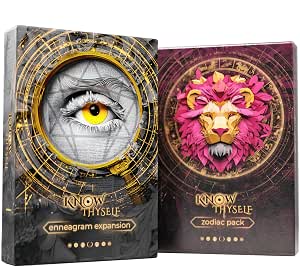 | Best for Extending a Group Game | Brand: Know Thyself | Card count: 40 cards: 24 Archetype Cards and 16 Depth Cards | Players: 2 to 4 | VIEW LATEST PRICE | See Our Full Breakdown |
| Enneagram Reflection Cards for Type 6 |  | Best for Type 6 Personal Reflection | Brand: Enneagram With Kate | Card count: 54 | Card dimensions: 3 × 4 in | VIEW LATEST PRICE | See Our Full Breakdown |
| What’s Your Type: The Type Dating Game |  | Best for Typography-Minded Players | Brand: Laurence King Publishing | Card count: 50 | Theme: Romantic dating game and typography | VIEW LATEST PRICE | See Our Full Breakdown |
| personality type card game | Brand | Card count | Age range |
|---|---|---|---|
| Enneagram Essentials: 125 Card | — | 125 | — |
| Know Thyself: The Game of Temp | Sophia Institute Press | — | 12 years and up |
| Enneagram Reflection Cards for | Enneagram With Kate | 54 | — |
| Two Types of People Party Game | WHAT DO YOU MEME? | — | 17 years and up |
| Enneagram Reflection Cards: Ty | — | — | — |
| Know Thyself Game Expansion Se | Know Thyself | 40 cards: 24 Archetype Cards and 16 Depth Cards | 18+ |
| Enneagram Reflection Cards for | Enneagram With Kate | 54 | — |
| What’s Your Type: The Type Dat | Laurence King Publishing | 50 | Listed as Kid |
More Details on Our Top Picks
Enneagram Essentials: 125 Cards for Self-Awareness and Connection
Enneagram Essentials earns the broadest role in this group because its 125-card deck is designed for both solo reflection and conversation. That makes it a more flexible starting point than the Type 9 and Type 4 reflection decks, which focus on one Enneagram type and personal prompts. Its structured approach can help people turn Enneagram concepts into discussion, though the deck is a reflection tool rather than a conventional competitive game. The tradeoff is that the system-specific material may be harder to use if players are new to Enneagram terminology; Know Thyself: The Game of Temperaments offers a different route based on temperament identification. Choose this deck for shared exploration across different settings, but skip it if you want party mechanics or a type-neutral format.
Pros:- 125 cards provide a wider range of material than the 54-card Type 9 reflection deck.
- Designed for both individual self-awareness and group connection.
- Structured around the Enneagram, giving discussion a clear personality framework.
Cons:- Its value depends on interest in or familiarity with Enneagram concepts.
- A physical deck is less convenient to carry than a digital tool.
- Reflection and discussion are the focus, not competitive game play.
Best for: Enneagram-curious individuals, couples, or groups who want one deck for both personal reflection and guided discussion.
Not ideal for: Players seeking a lively party game, or groups with little interest in learning or using the Enneagram framework.
- Format:Card deck
- Card count:125
- Personality framework:Enneagram
- Primary uses:Self-awareness and interpersonal connection
- Use settings:Individual reflection and group discussion
- ASIN:0593234561
Our verdict“Choose this for broad Enneagram-based reflection with others or on your own, rather than for a fast party game.”
Know Thyself: The Game of Temperaments
Know Thyself: The Game of Temperaments is the pick for players who want personality discussion organized around traits such as introversion, assertiveness, and focus, rather than Enneagram types. Its one-or-more-player format gives it an advantage over Two Types of People Party Game for Adults, which needs a group and leans on quick votes and guessing. The age guidance of 12 and up also makes this more suitable for younger players than that adult party option. Its tradeoff is a narrower play style: this is an educational temperament game, not a source of type-specific journaling prompts like the Type 4 deck. Choose it when learning how temperaments differ is the point; skip it if you want edgy humor, competitive party energy, or an Enneagram-specific tool.
Pros:- Focuses on temperament traits such as introversion, assertiveness, and focus.
- Can be played solo or with other players.
- Designed to encourage self-awareness and understanding of other temperaments.
- Age guidance makes it a more accessible group option for teens than the 17-and-up party game.
Cons:- Recommended for ages 12 and up, so it is not aimed at younger children.
- Its educational temperament focus may feel less playful than a party game.
- Does not provide the type-specific Enneagram reflection focus found in the Type 4 and Type 9 decks.
Best for: Families, educators, or small groups with players 12 and older who want a guided introduction to temperament differences.
Not ideal for: Groups seeking an adult party game, or Enneagram users who want prompts tailored to a specific type.
- Brand:Sophia Institute Press
- Age range:12 years and up
- Number of players:1 or more
- Language:English
- Container:Box
- Included components:1 game
- Educational objective:Self-awareness and interpersonal understanding through temperament identification and appreciation
Our verdict“Pick this for temperament-focused learning with teens or adults, not for a high-energy party or Enneagram journaling.”
Enneagram Reflection Cards for Type 9
Enneagram Reflection Cards for Type 9 is the most portable option here, with 54 lightweight cards measuring 3 × 4 inches. Its affirmations, questions, and prompts suit journaling or a short conversation, while Enneagram Essentials offers a larger set intended to work across individual and group exploration. The focused Type 9 content is a benefit for people who identify with that type and a clear limit for everyone else: it is not a general-purpose personality game. Compared with the Type 4 deck, its format and reflection uses are similar, but its prompts are aimed at a different Enneagram type. Choose this for a compact prompt deck to keep nearby or carry along; skip it if you need broad group play across multiple types.
Pros:- Compact 3 × 4 inch format is easy to carry.
- 54 cards offer prompts for journaling, mindfulness, and conversation.
- Type 9 focus makes the material more specific for people who identify with that type.
- Listed for use by adults, teens, families, and couples.
Cons:- Content is tailored to Enneagram Type 9, limiting its direct relevance to other types.
- Reflection prompts require personal participation rather than providing a structured group game.
- The smaller deck offers less material than the 125-card Enneagram Essentials set.
Best for: Type 9 individuals who want portable prompts for journaling, mindfulness, or low-pressure conversation at home or on the go.
Not ideal for: Mixed-type groups, or buyers who want a general Enneagram deck or a game with competitive rules.
- Personality type:Enneagram Type 9
- Card count:54
- Card size:3 × 4 inches
- Weight:0.19 kg
- Brand:Enneagram With Kate
- Style:Modern
- Content:Affirmations, questions, and prompts
Our verdict“Choose this if you identify with Type 9 and want a small, portable reflection deck rather than a broad group game.”
Two Types of People Party Game for Adults
Two Types of People Party Game for Adults is the most conventionally social pick here: players choose between contrasting statements while one person guesses how the group will vote. Its 300 type cards and voting paddles create a brisk, visible group activity, unlike the quieter journaling format of the Type 9 and Type 4 reflection decks. It works best as a conversation starter about preferences and habits, not as a structured personality assessment or Enneagram tool. The tradeoffs are substantial: it requires a group, supports up to eight players, and includes suggestive mature content for ages 17 and up. Compared with Know Thyself, this favors party interaction over educational temperament discussion. Choose it for an adult gathering, but skip it for family play or serious self-reflection.
Pros:- Simple rules make it quick to teach and start playing.
- 300 type cards provide a substantial range of prompts.
- Answer paddles make group voting and guessing interactive.
- Designed to spark conversation in group settings.
Cons:- Suggestive mature content limits suitability to players 17 and older.
- Requires a group and is not suited to solo reflection.
- Contrasting-statement play is less structured as personality learning than Know Thyself.
Best for: Adult friend groups of up to eight who want a quick voting-and-guessing party game with personality-themed prompts.
Not ideal for: Families with younger players, solo users, or buyers seeking a serious personality framework such as the Enneagram.
- Brand:WHAT DO YOU MEME?
- Age range:17 years and up
- Number of players:Up to 8
- Included components:300 type cards, 1 guesser’s paddle, 7 answer paddles, and instructions
- Material:Cardstock
- Model number:TTP4080
- UPC:810816036687
Our verdict“Choose this for an adult group that wants lively personality-themed voting, not for family use or reflective Enneagram work.”
Enneagram Reflection Cards: Type 4 – Self-Reflection and Personal Growth Deck
Enneagram Reflection Cards: Type 4 suits buyers who want affirmations, questions, and prompts aimed at one particular Enneagram type, especially for journaling, mindfulness, or relationship conversations. Like the Type 9 deck, it is a personal reflection tool rather than a rules-based game; its specific audience sets it apart from the broader Enneagram Essentials, which is designed for exploration across the Enneagram system. The small 3 × 4 inch format makes it practical to keep nearby, but the deck’s usefulness depends on identifying with Type 4 and setting aside time to engage with the prompts. Its listed uses include therapy and relationship building, though the cards are not a substitute for professional care. Skip it if you need prompts for multiple types or lively group mechanics.
Pros:- Type 4-specific affirmations and questions offer a focused reflection experience.
- Portable 3 × 4 inch cards suit use at home, work, or outdoors.
- Listed for journaling, mindfulness, therapy, and relationship building.
- Prompts can support personal reflection or meaningful conversation.
Cons:- The Type 4 focus limits direct usefulness for people of other Enneagram types.
- Cards rely on active participation and time for reflection.
- Like the Type 9 deck, it lacks the broader group-use scope of Enneagram Essentials.
Best for: Type 4 individuals, including teens and adults, who want portable prompts for journaling, mindfulness, or personal conversations.
Not ideal for: Mixed-type groups or buyers who want a general personality game, competitive play, or prompts that apply across the Enneagram.
- Enneagram type:Type 4
- Card size:3 × 4 inches
- Target audience:Men, women, teens, and adults
- Content type:Affirmations, questions, and prompts
- Use cases:Journaling, therapy, relationship building, and mindfulness
- Format:Card deck
Our verdict“Choose this if you identify with Type 4 and want a portable reflection aid, rather than a multi-type deck or party game.”
Know Thyself Game Expansion Set 1: Enneagram & Zodiac Pack
This expansion makes the most sense for groups who already enjoy Know Thyself: The Game of Temperaments and want more structured personality prompts. Its 24 Archetype Cards draw on Enneagram and Zodiac frameworks, while 16 Depth Cards push conversations beyond quick introductions toward more involved self-reflection. That mix gives returning players new angles without asking them to learn an entirely separate game. Compared with Enneagram Essentials: 125 Cards for Self-Awareness and Connection, this pack is a smaller, more game-specific add-on rather than a larger standalone prompt deck. The tradeoff is clear: it requires the original base game, and 40 cards offer less variety on their own. Its adult focus also makes it a poor fit for family play with younger participants.
Pros:- Combines Enneagram and Zodiac archetypes for more structured personality conversations.
- Includes 16 Depth Cards for prompts that go beyond introductory questions.
- Adds content for groups who have already played the base game.
- Uses a single double-sided box to reduce packaging.
Cons:- Cannot be played without the Know Thyself Standard Edition base game.
- Its 40 cards provide less standalone variety than a larger prompt deck.
- Designed for adults, limiting its use in younger or mixed-age groups.
Best for: Adults who already own Know Thyself Standard Edition and want fresh Enneagram- and Zodiac-based prompts for small-group game nights.
Not ideal for: Shoppers seeking a complete, standalone personality card game, or households looking for a deck suitable for children and mixed-age family play.
- Brand:Know Thyself
- Card count:40 cards: 24 Archetype Cards and 16 Depth Cards
- Players:2 to 4
- Age range:18+
- Theme:Self-discovery, Enneagram, and Zodiac
- Material:Cardstock
- Dimensions:5.9 × 3.64 in
- Requirement:Know Thyself Standard Edition Base Game
Our verdict“Choose this add-on if your group already owns Know Thyself and wants deeper Enneagram and Zodiac prompts; skip it if you need a complete game.”
Enneagram Reflection Cards for Type 6
This deck serves a narrower purpose than Enneagram Essentials: 125 Cards for Self-Awareness and Connection: it focuses on Type 6 rather than inviting broad exploration across personality types. The 54 cards pair positive affirmations with questions and prompts, so owners can use them for journaling, mindfulness, or a conversation with someone they trust. Their compact 3 × 4-inch format is easy to carry, but the main buying decision is whether Type 6 is the right focus. Compared with the multi-type scope of Enneagram Essentials, this deck may feel more personally relevant to Type 6 users, yet less useful for mixed-type groups or someone still figuring out their type. Reflection also takes time and openness; these cards are prompts, not a quick party-game format.
Pros:- Keeps all 54 cards focused on Type 6 themes.
- Offers prompts and affirmations for several reflective uses.
- Portable 3 × 4-inch cards are easy to carry.
- Can support journaling as well as conversations.
Cons:- Type 6 focus limits its usefulness for other Enneagram types.
- Prompts may bring up uncomfortable topics and call for time to reflect.
- Does not provide a structured competitive or party-game format.
Best for: Adults who identify with Enneagram Type 6 and want portable prompts for journaling, mindfulness, or thoughtful one-to-one conversations.
Not ideal for: Groups with varied or unknown Enneagram types, or buyers seeking lively, rules-based party gameplay rather than individual reflection.
- Brand:Enneagram With Kate
- Card count:54
- Card dimensions:3 × 4 in
- Material:Cardstock
- Theme:Enneagram Type 6
- Intended age:Adult
- Uses:Journaling, mindfulness, and conversation
Our verdict“Pick this deck for personal Type 6 reflection, but choose a broader Enneagram deck for mixed-type groups or wider coverage.”
What’s Your Type: The Type Dating Game
Unlike the Enneagram-centered prompts in Enneagram Reflection Cards for Type 6, this game treats “type” as typography: players explore fonts and type psychology through a dating theme. Its 50 font cards, booklet, and suggested four games give buyers more structure than an open-ended reflection deck, with an educational angle built around recognizing and discussing typefaces. That makes it a distinctive pick for design-curious players, classrooms, or gift recipients who enjoy visual culture. The tradeoff is that font interest is central to the experience; players looking for personality frameworks such as the Enneagram may find the theme mismatched. The listed age range is “Kid,” but the supplied details do not specify a minimum age, so buyers should check suitability for their group.
Pros:- Uses gameplay to introduce font recognition and type psychology.
- Includes 50 cards featuring different fonts.
- Booklet explains the subject and suggests four games.
- Gift box provides a ready-to-present format.
Cons:- Typography is the focus, not personality frameworks such as the Enneagram.
- The dating theme may not suit every group or setting.
- The supplied age listing lacks a specific minimum age.
Best for: Design-curious players, educators, and gift buyers seeking a playful card activity about fonts and typography rather than personality typing systems.
Not ideal for: Players expecting Enneagram or human personality-type prompts, or groups with little interest in fonts and visual design.
- Brand:Laurence King Publishing
- Card count:50
- Theme:Romantic dating game and typography
- Educational objective:Teach type psychology and font recognition through games
- Included booklet:Type psychology explanation and suggestions for four games
- Age range:Listed as Kid
- Item dimensions:4.75 × 2.13 × 6.25 in
- Operation mode:Manual
Our verdict“Choose this for a playful typography activity and an educational gift; skip it if you want cards about human personality types.”

How We Picked
I compared the eight options by how directly each supports personality-focused play, how easy its format is to use with the likely audience, and whether its scope matches a buyer’s intent. I gave more weight to decks that can serve a range of reflection or conversation needs than to products built around one type, a specific social setting, or an existing game.
The ranking reflects those differences rather than treating every deck as interchangeable. Enneagram Essentials leads for its broad self-awareness and connection purpose; Know Thyself follows as a distinct framework-led option. Social games rank higher for buyers who want group interaction, while type-specific decks and the expansion are more specialized choices. I also account for a practical limitation: a personality label or prompt deck should support conversation, not be treated as a definitive assessment.
| personality type card game | Brand |
|---|---|
| Enneagram Essentials: 125 Card | — |
| Know Thyself: The Game of Temp | Sophia Institute Press |
| Enneagram Reflection Cards for | Enneagram With Kate |
| Two Types of People Party Game | WHAT DO YOU MEME? |
| Enneagram Reflection Cards: Ty | — |
| Know Thyself Game Expansion Se | Know Thyself |
| Enneagram Reflection Cards for | Enneagram With Kate |
| What’s Your Type: The Type Dat | Laurence King Publishing |
Factors to Consider When Choosing Personality Type Card Games
Before choosing among personality type card games, decide what you want the cards to do. A deck for private reflection has different demands from one meant to get a mixed group talking, and a framework-specific product may be useful only if its language already interests you. These factors help separate a good match from a game that sounds appealing but does not fit the occasion.
Match the Game to the Setting
Start with where and with whom you expect to play: alone, with a partner, or around a group. Reflection prompts can invite more personal answers, which may suit a quiet conversation but feel too intimate at a casual gathering. Party formats usually put social momentum ahead of sustained self-analysis. A common mistake is choosing for the subject alone and overlooking the mood the game asks players to create. If your group varies in comfort with personal questions, favor a format that leaves room to answer lightly or pass. The best fit is the one people will actually feel comfortable bringing out.
Choose a Framework You Want to Explore
Enneagram-focused decks, temperament games, and products that combine Enneagram with zodiac material do not offer the same lens. Pick a framework because its ideas interest you, not because a label promises a complete account of someone’s personality. If your group is new to a system, a broader entry point can be easier than a deck dedicated to one type. Buyers already familiar with a framework may prefer more focused prompts for a narrower conversation. Avoid buying an expansion before checking whether you own the required base game. The right framework is the one that prompts useful discussion without asking players to accept its categories as fixed facts.
Decide How Much Personal Disclosure Feels Right
Card games about personality can range from playful comparisons to candid self-reflection. Think about whether players know one another well enough to discuss motives, habits, or personal growth. For a new group, low-pressure answers and the ability to skip a prompt can matter more than thematic depth. With close friends or a partner, more focused questions may lead to a richer exchange. Do not assume that a reflective title automatically makes a deck appropriate for therapy or diagnosis; these games are conversation tools. When comfort levels differ, set expectations before play and let people choose how much they share.
Check Whether It Works for the Whole Group
A game that depends on everyone knowing personality terminology may stall with first-time players. Consider whether the people joining are interested in self-analysis, prefer humor, or simply want an easy social activity. A mixed group often benefits from accessible prompts that do not require prior study or agreement about personality systems. The reverse mistake is bringing a party-style game to people who want detailed individual reflection. Think about group size and how much attention each player gets, since a format built around personal turns can feel slow with a crowd. A strong match respects both the group’s knowledge and its energy.
Treat Type-Specific Decks as Focused Tools
A deck centered on one Enneagram type can offer relevant prompts to someone who identifies with that type, but it is a narrower purchase than a general deck. It may be less useful for a household, group, or gift recipient whose type is unknown. Do not select a type-specific product only because its label sounds familiar; consider whether the intended player wants prompts tied to that identity. These decks may also work as complements to broader reflection rather than replacements for them. For a gift, a general-purpose option is often a safer choice when you do not know the recipient’s framework or type. Focused content makes the most sense when the player has already chosen that lens.
Prioritize Repeat Use Over Novelty
A clever theme can make a game appealing once, but repeated use depends on how well its prompts support fresh conversations. Before buying, ask whether you want a one-evening icebreaker, an ongoing reflection practice, or a game to revisit with different people. A specialized deck can feel highly relevant to its intended audience yet have limited reach outside it. A broader game may suit more occasions, even if its questions are less tailored. For an expansion, check how it changes the base game and whether its added themes are ones your group will use. Choose for the occasions you can realistically name, rather than assuming every deck will become a regular routine.
Frequently Asked Questions
Which personality type card game is the safest choice for a mixed group?
Enneagram Essentials is the strongest general starting point in this lineup because its stated focus combines self-awareness with connection rather than targeting one personality type. If your group would rather keep the mood light, Two Types of People Party Game for Adults is more explicitly social. Before playing any personality-focused game with a mixed group, explain that answers can be brief and nobody needs to share anything personal. That simple expectation can make a reflective activity feel more welcoming without changing the game.
Should I buy an Enneagram reflection deck if I do not know my type?
A type-specific deck is a narrower choice if you have not identified with that type or are still learning the framework. The Type 9, Type 4, and Type 6 decks are best approached as focused reflection options, not broad introductions that cover every type. If you are unsure, start with a more general Enneagram-oriented product or a game based on another framework. You can also treat a type label as a prompt for discussion rather than a conclusion about yourself. That keeps the activity exploratory instead of making the deck feel like a test.
Can I use Know Thyself Game Expansion Set 1 without the original game?
The product is identified as an expansion, so buyers should not assume it works as a standalone game. Check the packaging or seller’s product details for the base game requirements and included components before purchasing. The expansion makes the most sense for someone who already owns Know Thyself and wants the Enneagram and zodiac material it adds. If you do not own the base game, compare the combined purchase against a standalone option that fits your group. This avoids ending up with cards that need another product to be playable.
Are personality type card games suitable for serious self-assessment?
These games are better treated as conversation and reflection aids than as formal assessments. A prompt can help someone notice a habit or explain a preference, but it cannot establish a fixed personality profile on its own. Framework-based labels may also feel different to different players, so discussion matters more than reaching a single correct answer. For serious personal or clinical questions, use appropriate professional guidance rather than relying on a card game. This distinction lets the game be useful without giving its labels more authority than they deserve.
What makes a better gift: a broad personality game or a type-specific deck?
A broad option is usually the safer gift when you do not know the recipient’s personality framework, type, or comfort with personal prompts. A type-specific deck can feel more thoughtful when you know the recipient actively identifies with that type and enjoys reflection. For a social host, a party-oriented title may be a better fit than a self-growth deck. Consider whether the recipient prefers structured questions, playful group interaction, or private reflection before choosing. If that preference is unclear, avoid a specialized deck that depends on a label the recipient may not use.
Conclusion
My best overall pick is Enneagram Essentials for buyers who want a flexible focus on self-awareness and connection. Choose Know Thyself: The Game of Temperaments if temperament is the framework you want to explore, and consider the Know Thyself expansion only if you own the base game and want its added themes. For a social occasion, Two Types of People is the clearest party-oriented choice; for dating-focused play, What’s Your Type: The Type Dating Game is the specialized option. Beginners should lean toward a broad, accessible game instead of starting with a type-specific deck, while players who already identify with Type 9, Type 4, or Type 6 may prefer the matching reflection cards. These options are not directly comparable on price or physical build from the available product information, so I would choose by audience, framework, and intended use rather than assume one is the best value. Select the game that fits the conversation you want to have, not just the personality label on the box.