For a Halloween gathering built around personality, perception, and spooky subjects, I’d start with Psychological for group-based social guessing, Horrible Therapist: Extra Horrible Edition for adult comic-making, or Distinctivs Halloween Games Pack for direct phobia-themed activities. They take notably different approaches: one asks how well friends read each other, one turns therapy into deliberately outrageous humor, and one pairs Halloween trivia with phobia matching. Halloween Who Am I? is the simpler icebreaker if your main goal is getting guests talking without a long rules explanation.

Turn your wind-down time into listening time
- Thousands of audiobooks, podcasts and originals
- Listen on your phone, tablet or Echo — also offline
- Cancel anytime
My ranking favors the strength of each game’s fit with the psychology-themed Halloween brief, then its ease of use, audience range, and ability to support a party group. The main tradeoff is between psychological depth and spooky specificity: Psychological is the strongest social-perception game but has no explicit Halloween theme, while Distinctivs has the most direct phobia connection but a smaller set of cards. For adults who enjoy edgy jokes, Horrible Therapist offers much more creative variety; for mixed-age groups, Who Am I? keeps the mood lighter and simpler.
Key Takeaways
- Best social-perception choice: Psychological asks players to predict one another’s traits, but its general party theme needs Halloween decoration or prompts to feel seasonal.
- Best for adult humor: Horrible Therapist has 438 cards and supports three to eight players, but its therapy-comic jokes may not suit every group.
- Most directly Halloween-and-phobia themed: Distinctivs combines trivia and phobia matching in 25 dual-sided cards, though that smaller supply may call for rotating players.
- Easiest mixed-age icebreaker: Halloween Who Am I? is quick to explain and includes 20 DIY cards, but its 30 character cards can feel limited for a large party.
- Choose by group and tone: Psychological and Horrible Therapist suit groups of three or more; Who Am I? is the most flexible for casual mingling, while Distinctivs is aimed at ages 16 and up.
| Psychological – The Social Perception Board Game, for 3-6 Players, Ages 8+ |  | Best Overall for Social Perception | Players: 3-6 | Age guidance: 8 and up | Components: Board, 250 cards, 6 magnetic scoring tiles, 6 character pieces, scoring trophy | VIEW LATEST PRICE | See Our Full Breakdown |
| Horrible Therapist: Extra Horrible Edition by Exploding Kittens |  | Best for Adult Humor and Creative Replay | Players: 3-8 | Age guidance: 17+ | Number of cards: 438 | VIEW LATEST PRICE | See Our Full Breakdown |
| Distinctivs Halloween Games Pack: Halloween Trivia and Phobia Match |  | Best for Direct Halloween and Phobia Content | Cards: 25 dual-sided cards | Card size: 5 x 7 inches | Material: Paper | VIEW LATEST PRICE | See Our Full Breakdown |
| Halloween Who Am I? Guessing Party Game with Character and DIY Cards |  | Best Beginner-Friendly Icebreaker | Character cards: 30 | DIY cards: 20 | Package dimensions: 7.01 x 5.31 x 0.43 inches | VIEW LATEST PRICE | See Our Full Breakdown |
| psychology-themed Halloween party game | Age guidance | Players | Brand | Package dimensions |
|---|---|---|---|---|
| Psychological | 8 and up | 3-6 | PlayMonster | — |
| Horrible Therapist: Extra Horr | 17+ | 3-8 | Exploding Kittens | — |
| Distinctivs Halloween Games Pa | 16 years and up | — | — | 7 x 5 x 0.1 inches |
| Halloween Who Am I? Guessing P | — | — | — | 7.01 x 5.31 x 0.43 inches |
More Details on Our Top Picks
Psychological – The Social Perception Board Game, for 3-6 Players, Ages 8+
Psychological earns my top position because its central activity—guessing how other people see personality traits—connects most directly to social psychology among these four. Players use insight into friends and family rather than relying only on Halloween facts or character clues. That gives it a distinctive role at a party where the host wants conversation about how people think, behave, and interpret one another.
Its 250 cards and stated thousands of trait combinations give it a more substantial tabletop format than the small Halloween activity packs. Compared with Who Am I?, it puts personality perception, rather than identifying a spooky character, at the center of play. It also offers a more family-accessible tone than Horrible Therapist, which is restricted to adults and deliberately leans into potentially offensive humor. The age guidance starts at eight, but the game still calls for everyone to follow rules and read cards, so it works best with a group ready to sit down together rather than a stream of guests coming and going.
The main compromise is seasonal: the supplied description does not specify Halloween content. I’d dress up the table, add Halloween snacks, or pair it with spooky prompts if the party needs a strong visual theme. Its cap of six also makes it a poor fit for a big crowd unless guests take turns. I rank it above the more explicitly themed options because the psychology connection is its core mechanic, but buyers looking for phobias, ghosts, or Halloween trivia on the cards should choose Distinctivs instead.
Pros:- Social-perception guessing makes psychology central to play.
- 250 cards support varied combinations across sessions.
- Stated ages eight and up make it more family-flexible than the adult-only option.
- Board, scoring tiles, character pieces, and trophy provide a structured group activity.
Cons:- The listed theme is social perception, not Halloween, so seasonal atmosphere comes from the host.
- A maximum of six players limits use with a large party.
- Reading and understanding the rules may be less convenient for casual drop-in play.
Best for: Hosts who want a seated, family-accessible game about reading personality traits among three to six players.
Not ideal for: Large groups needing everyone to play at once, or buyers who want Halloween imagery and spooky prompts built into the game.
- Players:3-6
- Age guidance:8 and up
- Components:Board, 250 cards, 6 magnetic scoring tiles, 6 character pieces, scoring trophy
- Dimensions:10.5 x 10.5 x 0.1 inches
- Brand:PlayMonster
- Model number:26139
Our verdict“I’d choose Psychological for the strongest personality-reading experience, provided the group is small enough and the host is happy to add the Halloween atmosphere.”
Horrible Therapist: Extra Horrible Edition by Exploding Kittens
If the party is adults-only and enjoys irreverent jokes, Horrible Therapist: Extra Horrible Edition is the most expansive option here. Players combine Question, Answer, and Treatment cards to make humorous therapy comics, so the psychology angle comes from the parody of therapy rather than personality analysis. Its 438 cards give it a much broader creative toolkit than the 25-card Distinctivs pack or the 30 character cards in Who Am I?
That size makes it better suited to repeat rounds where players want new combinations, and the portable card format is easier to bring to another gathering than a board-and-pieces game. Compared with Psychological, this is less about accurately reading friends and more about making an absurd comic from prompts. That distinction matters: guests who want insight into personality may prefer Psychological, while those looking for adult party comedy may get more from this game. It supports three to eight players, giving it a slight group-size advantage over Psychological.
The age limit of 17 and up is a firm boundary, not a minor caveat. Its humor may be inappropriate or offensive to some players, and the supplied description does not position it as a Halloween-specific game. I’d treat it as an adult party pick that can sit alongside costumes and decorations, not as the most literal spooky game in the roundup. It also needs several people to bring the card combinations to life, so it is not a strong choice for a small two-person gathering or a party where guests prefer gentle, family-safe humor.
Pros:- 438 cards provide a broad range of comic combinations.
- Question, Answer, and Treatment cards give players a clear creative format.
- Supports three to eight players, more than the Psychological board game.
- Portable card-based format is convenient for game nights away from home.
Cons:- Rated for ages 17 and up, so it is not a family-friendly choice.
- Humor may not suit every adult group.
- Therapy humor is explicit in the concept, but Halloween content is not specified.
Best for: Adult groups of three to eight who enjoy irreverent therapy parody, collaborative joke-making, and varied card combinations.
Not ideal for: Families with children, guests who dislike edgy or potentially offensive humor, or hosts seeking explicit Halloween subject matter.
- Players:3-8
- Age guidance:17+
- Number of cards:438
- Card material:Cardstock
- Edition:Extra Horrible Edition
- Brand:Exploding Kittens
- Model year:2024
Our verdict“I’d pick Horrible Therapist for an adult group that values outrageous comic combinations over family play or Halloween-specific questions.”
Distinctivs Halloween Games Pack: Halloween Trivia and Phobia Match
Distinctivs Halloween Games Pack is the clearest match for a host who wants the spooky theme printed directly on the activity. Its two-sided cards combine Halloween trivia with a phobia matching game, making it the most explicit link between Halloween and a psychology-adjacent subject in this list. The included answer keys also reduce preparation: a host can set out the cards and get started without building a separate quiz.
Compared with Psychological, this pack trades sustained personality-reading play for short, topic-based activities. That can work better for guests who want a quick round rather than a full board game, and its orange-and-black design reinforces the occasion without extra styling. Its phobia angle is more specific than the broad character guessing in Who Am I?, although the activity is matching rather than an in-depth exploration of fears. The stated age range of 16 and up also makes it less flexible than the family-oriented options.
The 25 dual-sided cards are the main limitation. A single host-led round may suit a small gathering, but a large party could move through the available material quickly, particularly if guests want multiple rounds. There is no timer, so anyone hoping for a fast competitive quiz will need to supply their own pacing. I place it below Psychological and Horrible Therapist because its direct theme fit is strong but its card supply and activity depth are more limited. For a seasonal add-on or a short hosted game, however, that tradeoff may be exactly right.
Pros:- Combines Halloween trivia with phobia matching in one pack.
- Answer keys support quick setup and host-led play.
- Dual-sided cards offer two activity types.
- Orange-and-black artwork fits a Halloween party without extra theming.
Cons:- Only 25 cards may limit repeated play or use with a large group.
- No timer is included for hosts who want timed competition.
- Age guidance starts at 16, excluding younger children.
Best for: Hosts of teen and adult Halloween parties who want quick trivia and phobia-matching rounds with answer keys included.
Not ideal for: Young children, large groups expecting many rounds, or buyers who want a deep social-perception game with a substantial deck.
- Cards:25 dual-sided cards
- Card size:5 x 7 inches
- Material:Paper
- Age guidance:16 years and up
- Activities:Halloween trivia and phobia matching
- Included components:Answer keys and game cards
- Package dimensions:7 x 5 x 0.1 inches
Our verdict“I’d choose Distinctivs when direct Halloween and phobia content matters more than a large card pool or ongoing personality-based play.”
Halloween Who Am I? Guessing Party Game with Character and DIY Cards
Halloween Who Am I? is the easiest entry point when the host needs guests to start talking without a substantial rules briefing. Players guess spooky characters, a familiar party mechanic that encourages conversation and teamwork. Its Halloween subject is clear, and the 20 DIY cards give the host a way to create personalized prompts—useful if the group shares favorite films, office jokes, or locally familiar characters.
That flexibility distinguishes it from Distinctivs: the latter supplies trivia and phobia matching, while Who Am I? invites guests to build clues around identities and characters. It is also a lighter, less structured alternative to Psychological, which includes a board, scoring pieces, and a larger card set. I’d favor Who Am I? when guests will be mingling or when the group includes people who may not want a sit-down game. It is the least demanding option in this lineup to explain, based on the supplied description.
The short deck is the obvious tradeoff. With 30 character cards and 20 DIY cards, a large party may use up familiar prompts quickly, and the description notes that extra purchases may be needed for bigger groups. The DIY cards help with customization but ask the host to contribute ideas rather than simply relying on a ready-made supply. It also focuses on character guessing, so it has a looser connection to psychology than the social-perception mechanics of Psychological or the phobia subject in Distinctivs. I rank it fourth for the psychology-specific brief, while still seeing it as a sensible choice for simple Halloween icebreaking.
Pros:- Quick-to-learn guessing format suits first-time players.
- Includes 30 character cards and 20 DIY cards.
- Customizable prompts can reflect the group or party.
- Designed for conversation and teamwork rather than complex scoring.
Cons:- The available card count may be limited for large groups or repeated rounds.
- DIY cards require the host to supply additional prompts.
- Character guessing has a less direct psychology focus than social perception or phobia matching.
Best for: Hosts who want a quick, approachable Halloween guessing game for casual groups, mixed ages, or office gatherings.
Not ideal for: Large parties needing a large ready-made card pool, or buyers seeking substantial personality or phobia content.
- Character cards:30
- DIY cards:20
- Package dimensions:7.01 x 5.31 x 0.43 inches
- Item weight:2.39 ounces
- Suggested settings:Halloween parties, family gatherings, office events
- Gameplay focus:Spooky-character guessing, conversation, and teamwork
Our verdict“I’d pick Who Am I? for a low-pressure Halloween icebreaker, not for a party whose main goal is psychology-focused gameplay.”
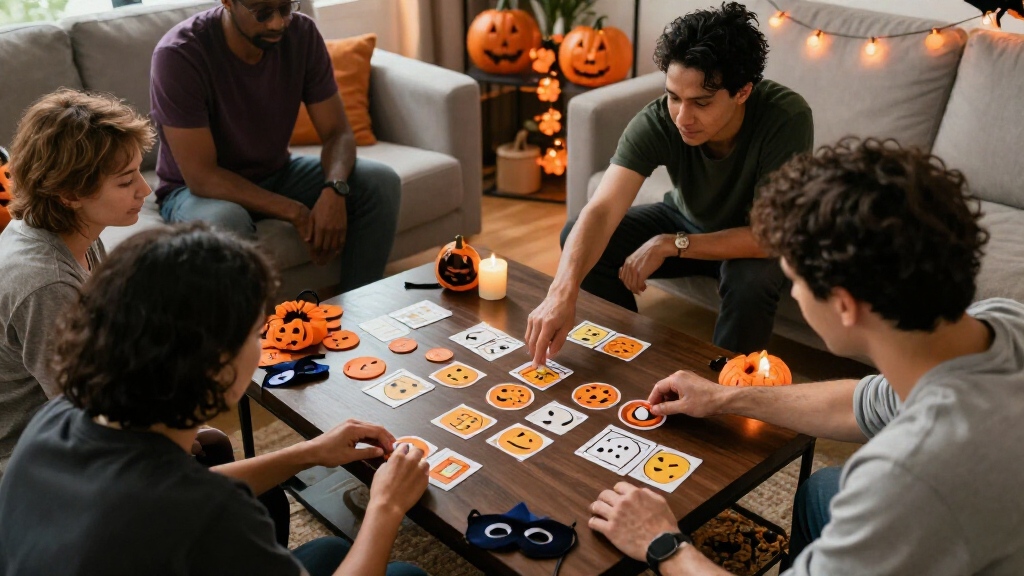
How We Picked
I ranked these four games by how convincingly they connect Halloween party play with psychology-related ideas, rather than treating any spooky-looking activity as an automatic match. Social perception, personality guessing, therapy humor, and phobia recognition can all suit the theme, but they create very different evenings. My leading pick is the game that makes reading other people central; the other positions reflect narrower strengths such as adult humor, explicit Halloween content, or low-friction icebreaking.
I also weighed practical party fit: the stated player count and age range, the amount of material included, setup demands, and whether a host can bring latecomers into a round. A large card supply can help a game vary across repeated plays, but it does not make adult jokes appropriate for a family gathering. Likewise, simple rules are useful when guests are arriving at different times, while a structured board game may work better when everyone can sit together.
The descriptions and specifications supplied for these products form the basis of this guide. I do not treat product claims such as “endless” variations as a guarantee of unlimited replay, and I distinguish direct theme fit from a game that needs Halloween styling to match the occasion. Audience suitability and meaningful drawbacks count alongside strengths: the adult-only tone, player caps, limited card counts, and absence of a timer all affect which option makes sense for a particular party.
| psychology-themed Halloween party game | Brand |
|---|---|
| Psychological | PlayMonster |
| Horrible Therapist: Extra Horr | Exploding Kittens |
| Distinctivs Halloween Games Pa | — |
| Halloween Who Am I? Guessing P | — |
Factors to Consider When Choosing Psychology-themed Halloween Party Games
I’d choose among these games by deciding what “psychology-themed” means for the party. It could mean reading personality, making jokes about therapy, matching phobias, or simply getting people to talk through clues. Once the group’s age, size, and preferred tone are clear, the differences between the four picks become easier to judge.
Decide whether psychology or Halloween should lead
If the main goal is to explore how people interpret each other, Psychological is the strongest match: personality traits and social perception drive the game. If the party needs unmistakable Halloween content on the cards, Distinctivs is more direct, combining trivia with phobia matching. Horrible Therapist offers a comic take on therapy, but its Halloween fit comes from the setting you create rather than the supplied theme. Who Am I? is clearly seasonal but centers on spooky-character clues, so it is the loosest match for a psychology-first gathering.
I’d treat these as different kinds of thematic fit, not interchangeable versions of the same game. A host can also pair a psychology-centered game with Halloween decorations, but decoration cannot turn adult humor into family play or expand a small card set. Start with the experience you want guests to have, then choose the game that supplies it directly.
Match the game to guest ages and humor
For a family gathering that includes children, Psychological has the broadest stated age guidance at eight and up. Who Am I? is described as suitable for all ages, which makes its simple guessing format appealing for a mixed-age room, though its card supply is modest. Distinctivs starts at 16, while Horrible Therapist is for ages 17 and up and may include jokes some adults would rather avoid.
Age guidance is only one part of the decision. Consider whether guests are comfortable with therapy jokes, phobia topics, or reading personal traits aloud. A group that enjoys playful observation may welcome Psychological; a group that prefers silly identity clues may be happier with Who Am I? I would avoid selecting an adult humor game for a mixed-age event simply because it has more cards or supports a larger group.
Check player count and party flow
Psychological is stated for three to six players, and Horrible Therapist for three to eight. Those ranges suit a table where players can stay together for a round. A party with many guests may need to split into groups or rotate players, particularly with Psychological’s six-person limit. Who Am I? is presented for parties and gatherings without a stated player cap, but its limited card count still affects how long it can sustain a large group. Distinctivs is a short activity pack rather than a specified player-count game.
Think about whether the event has a fixed game period or constant arrivals and departures. A structured board game asks players to settle in and follow rules, whereas a guessing icebreaker can be easier to introduce as guests mingle. Answer keys make Distinctivs straightforward to host, but the lack of a timer leaves pacing to the organizer. For drop-in play, I’d favor easy instructions and rounds that do not depend on every guest being present from the start.
Use card count as a guide, not a promise
The listed quantities help explain the range of play, but card totals do not measure how enjoyable a game will be for a particular group. Horrible Therapist has 438 cards, which supports many possible comic combinations. Psychological includes 250 cards and a set of board components for a more structured activity. Distinctivs has 25 dual-sided cards, and Who Am I? includes 30 character cards plus 20 DIY cards. The latter two can be enough for a brief party activity, but a host planning repeated rounds for many guests should be mindful of the smaller pools.
Customization changes that calculation. Who Am I?’s DIY cards let a host add prompts that matter to the group, though that requires some preparation. Distinctivs supplies answer keys, reducing the work of running its included activities. When comparing the options, ask whether you want a ready-made collection, a flexible prompt format, or a short themed activity. More material helps only when the game’s tone and format suit the guests.
Choose between structure and easy setup
A board, scoring pieces, and rules can give Psychological a more focused shared session, but they ask for a table and attention from the players. Card-based Horrible Therapist is portable and built around making combinations. Distinctivs provides answer keys for quick hosting, while Who Am I? is designed around a familiar guessing format and includes instructions. If guests are arriving in waves, a simple icebreaker may be easier to restart than a game where players need to remember a longer sequence.
Hosts can reduce friction by explaining the activity before distributing materials and by setting a clear round length. For a more competitive session with Distinctivs, bring a timer or agree on a time limit, since one is not included. For a party using Psychological, decide whether the six-player limit means rotation or separate tables. These small choices help the game fit the room rather than asking the room to fit the game.
Keep phobia content comfortable for the room
Phobias can make for a fitting Halloween topic, but they also touch on real fears. Distinctivs includes phobia matching, so I’d choose it for a group that is comfortable with that subject and keep the activity light rather than treating anyone’s fear as a punchline. The other games give hosts different routes: personality traits in Psychological, fictional character guessing in Who Am I?, and parody therapy humor in Horrible Therapist.
For a workplace or mixed-comfort group, it can help to explain the tone before play and let guests pass on a prompt. That approach does not change the game’s contents, but it gives the host a way to keep the activity welcoming. If the group prefers to avoid both phobias and edgy jokes, Who Am I? or Psychological offers a more suitable starting point, depending on whether seasonal character clues or personality reading matters more.
Frequently Asked Questions
Which game has the strongest psychology focus?
I’d choose Psychological for the clearest focus on social perception, since players try to understand and predict personality traits. Horrible Therapist uses therapy as a comic premise, while Distinctivs addresses phobias through a matching activity. Who Am I? encourages conversation but centers on guessing Halloween characters rather than analyzing personality.
Which option is best for a family Halloween party?
Psychological is listed for ages eight and up and supports a family-style seated game for three to six players. Who Am I? is described as suitable for all ages and has a simpler guessing format, which may be easier when children and adults are mingling. I would skip Horrible Therapist for a family group because it is rated 17 and up, and Distinctivs is aimed at ages 16 and up.
Which game is most directly Halloween-themed?
Distinctivs Halloween Games Pack has the most explicit seasonal material, with Halloween trivia, spooky artwork, and phobia matching. Who Am I? also has a clear Halloween identity through its spooky-character cards. Psychological is about social perception without a stated Halloween theme, and Horrible Therapist is an adult therapy-comedy game rather than a specifically Halloween product.
Which game works best for a larger adult group?
Horrible Therapist has the largest stated player range here, supporting three to eight people, and its 438 cards provide many possible combinations. That does not make it right for every adult group: the humor can be offensive to some, and it is restricted to ages 17 and up. Psychological is capped at six, while the other two descriptions do not specify a formal player count.
Can Distinctivs or Who Am I? support repeated rounds?
Both can suit multiple short activities, but their supplied card counts are smaller than those of Psychological and Horrible Therapist. Distinctivs includes 25 dual-sided cards with two activity types and answer keys; Who Am I? includes 30 character cards and 20 DIY cards that a host can customize. For a large gathering or repeated play, I’d plan to rotate guests, add original prompts where appropriate, or choose a game with a larger stated card pool.
Conclusion
For a party where the central appeal is reading personalities and testing social perception, I’d choose Psychological, especially for a seated group of three to six that can add its own Halloween atmosphere. If the guests are adults who enjoy irreverent therapy jokes and collaborative comic-making, Horrible Therapist is the stronger fit, with a larger card supply and room for up to eight players. For a direct seasonal activity built around trivia and phobia matching, Distinctivs makes the most sense when a short deck is enough and the group is comfortable with the subject.
For a host who values simple rules, mixed-age participation, and easy conversation over deep psychological play, I’d pick Halloween Who Am I? Its DIY cards let the host tailor prompts, but the smaller ready-made set suits a casual icebreaker better than a long tournament. My final choice comes down to the party’s mood: personality insight with Psychological, adult comedy with Horrible Therapist, spooky subject matter with Distinctivs, or low-pressure guessing with Who Am I?
Halloween Picks
halloween
As an affiliate, we earn on qualifying purchases.