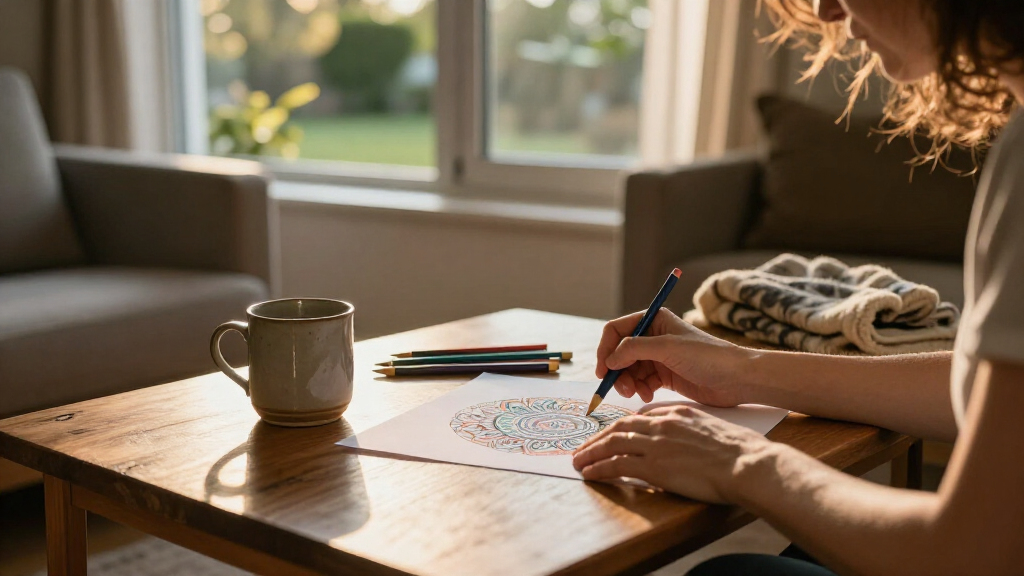

Choosing a stress relief coloring book is less about finding a universally calming design and more about deciding how much attention you want coloring to ask of you. Intricate mandala books fill pages with small shapes, repeating patterns, and fine details. Simple nature books use broader areas and recognizable subjects such as leaves, flowers, birds, and landscapes. Both can offer a screen-free activity and a reason to slow down, but the experience differs: mandalas invite extended concentration, while simpler nature scenes are easier to approach when your energy is low or your time is short.

Turn your wind-down time into listening time
- Thousands of audiobooks, podcasts and originals
- Listen on your phone, tablet or Echo — also offline
- Cancel anytime

Adult Coloring Book with Animals, Flowers, Fantasy, and More for Mindfulness and Relaxation
- ✔ Format: Adult coloring book
- ✔ Subjects: Animals, flowers, fantasy, and more
- ✔ Intended use: Mindfulness and relaxation

Mindfulness Coloring Book for Adults – Feel the Zen with Stress-Relieving Designs of Animals, Mandalas, and Zentangle Nature Art
- ✔ Format: Physical adult coloring book
- ✔ Subjects: Animals, mandalas, and zentangle nature art
- ✔ Intended use: Mindfulness and stress relief

Inspiring Calm: Ancient Images of Peace and Serenity – A Coloring Book for Grown-Ups
- ✔ Format: Adult coloring book
- ✔ Art direction: Ancient images inspired by peace and serenity
- ✔ Intended use: Relaxation and mindfulness
That difference matters if coloring is meant to be a small, repeatable part of your routine. A highly detailed page can feel absorbing to someone who likes careful, deliberate work; to someone else, it can feel like another task to finish neatly. A roomy nature illustration may be more forgiving and easier to pick up for ten minutes, though it may provide less intricate work for someone who wants a sustained focus challenge. Neither format guarantees a particular mental health benefit, and individual preferences vary. This comparison looks at page detail, effort, session length, flexibility, supplies, variety, and value so you can choose the format you are more likely to enjoy using.
At a Glance
| Criteria | Intricate mandala coloring books | Simple nature coloring books | Winner |
|---|---|---|---|
| Page detail | Dense, repeating patterns with many small spaces | Broader shapes and open areas in recognizable natural scenes | Depends |
| Attention and effort | Higher focus and steadier hand control | Lower entry effort; detail varies by illustration | B |
| Short-session ease | A small section can be colored, but pages may feel unfinished | Easy to make visible progress in a brief session | B |
| Coloring flexibility | Works well with fine-tip pens or sharpened pencils | Supports broad color fills, simple shading, or mixed approaches | B |
| Supply needs | Fine tips and pencils can make small areas easier | A basic pencil or crayon set is often enough | B |
| Subject variety | Often centers on mandalas, geometric patterns, and ornamental designs | Can range across plants, animals, gardens, and landscapes | Depends |
| Value for regular use | Worth paying more for if detailed pages are a lasting preference | Often the safer value choice for casual or uncertain users | B |
Adult Coloring Book with Animals, Flowers, Fantasy, and More for Mindfulness and Relaxation
For a book meant to help us unwind, variety can be more useful than a single signature style. This collection moves among animals, flowers, and fantasy scenes, giving us options when a particular subject or level of detail stops feeling relaxing. That range makes it our best overall choice in this group, especially for readers who want one book to suit changing moods instead of committing to a consistent ancient-art theme or a recognizable mandala-and-nature focus.The description positions the illustrations for colorists at different skill levels, which gives this pick broader appeal than Inspiring Calm, whose complex designs may feel more demanding. It also differs from Mindfulness Coloring Book for Adults: both include animals, but the latter names mandalas and zentangle nature patterns specifically. Here, the advantage is the wider thematic spread, not a clearly defined pattern style.There are limits to that flexibility. The book provides black-and-white line art only, with no colored examples to help us get started or offer palette inspiration. Paper and layout details are also absent, so we cannot confidently recommend it for marker-heavy sessions. Choose it for its changing subjects and skip it if reference colors or verified paper performance are central to your relaxing routine.
Pros:
- Animals, flowers, and fantasy scenes provide varied subjects.
- Designed with mindfulness and relaxation in mind.
- Described as suitable for colorists at different skill levels.
- A broader theme mix than the two more stylistically focused alternatives.
Cons:
- Includes black-and-white line art without colored reference pages.
- Paper thickness and page layout are not specified.
- No stated palette guidance for color selection.
Best for: Adults who want several subject types in one book and prefer to choose a page based on their mood.
Not ideal for: Colorists who rely on colored examples, want a dedicated mandala collection, or need confirmed paper details for a particular medium.
Bottom line: We recommend it for the widest choice of calming subjects, provided we are comfortable selecting colors without examples.
“We recommend it for the widest choice of calming subjects, provided we are comfortable selecting colors without examples.”
Mindfulness Coloring Book for Adults – Feel the Zen with Stress-Relieving Designs of Animals, Mandalas, and Zentangle Nature Art
If we find steady, repeatable patterns more soothing than hopping among unrelated themes, this book has the most clearly described combination. Its lineup brings together animals, mandalas, and zentangle nature art, so we can move between recognizable subjects and intricate designs while keeping a mindfulness focus. That specificity sets it apart from our overall pick, which offers more varied themes but does not mention mandalas or zentangle patterns.The book is presented as suitable for both beginners and experienced colorists. That broad skill range is appealing when we want to start with a simpler-feeling subject and later choose a more involved pattern, although the listing does not say how difficulty is distributed page to page. Compared with Inspiring Calm, this option sounds more varied in subject and explicitly includes animals and mandalas rather than concentrating on ancient imagery.Our main reservation is practical: paper quality is not specified, which leaves marker compatibility uncertain. The description also says there is no digital version, a drawback for readers who prefer coloring on a tablet or keeping creative materials off paper. It makes the most sense for a physical, pattern-rich coloring routine, but not for buyers who need verified media support or a digital format.
Pros:
- Combines animals, mandalas, and zentangle nature art.
- Explicitly intended to support mindfulness and stress relief.
- Described as suitable for beginners and experienced colorists.
- Offers more specified pattern types than the broad-theme overall pick.
Cons:
- Paper quality is not specified, leaving marker use uncertain.
- No digital version is available according to the description.
- No color palette guidance is mentioned.
Best for: Adults who want a physical book that combines mandalas, animals, and nature patterns for mindful coloring.
Not ideal for: Digital-first colorists or anyone choosing a book primarily by paper thickness and marker compatibility.
Bottom line: We would choose it for the most clearly defined mix of familiar mindfulness patterns, while accepting uncertainty about the paper.
“We would choose it for the most clearly defined mix of familiar mindfulness patterns, while accepting uncertainty about the paper.”
Inspiring Calm: Ancient Images of Peace and Serenity – A Coloring Book for Grown-Ups
Some of us relax more easily when a book sustains one visual mood from page to page. Inspiring Calm is the most focused choice here: its artwork draws on ancient imagery associated with peace and serenity, creating a more cohesive direction than the shifting animals, flowers, and fantasy themes of our top pick. That makes this book a good match for readers who want the atmosphere of the art itself to set the tone of a coloring session.Its stated single-sided pages are a useful distinction from the other two listings, which do not specify page layout. They may help us avoid coloring on the reverse side of an illustration, particularly with pens or markers, though the description does not establish the paper’s thickness. Heavy media such as watercolor are specifically a poor fit. Compared with the mindfulness title’s mix of mandalas, animals, and nature patterns, this book trades subject variety for a more unified ancient-art concept.The same focus may also limit who enjoys it. Intricate designs can ask for sustained attention, and the listing warns that the book is not suited to children. No palette guidance is provided, so we will still be making our own color decisions. Choose it for its distinctive, contemplative artwork and one-sided layout; skip it if we want simpler pages, broad subject variety, or reliable support for heavy wet media.
Pros:
- Ancient-inspired artwork gives the book a distinct, cohesive mood.
- Designed for adult relaxation and mindfulness.
- Single-sided pages are stated to help with pens or markers.
- Offers a more unified visual direction than the other two books.
Cons:
- Paper thickness may not support heavy media such as watercolor.
- Color palette guidance is limited, so color choices are left to the reader.
- Complex designs may feel too demanding for a quick, low-effort session.
Best for: Adults drawn to intricate ancient-inspired art who value single-sided pages for pens or markers.
Not ideal for: Readers seeking simple designs, a broad range of subjects, child-friendly pages, or paper confirmed for watercolor.
Bottom line: We would pick it for a consistent ancient-art mood and single-sided pages, while avoiding it for watercolor or easy, simple coloring.
“We would pick it for a consistent ancient-art mood and single-sided pages, while avoiding it for watercolor or easy, simple coloring.”
As an Amazon Associate we earn from qualifying purchases.
Key Differences
The clearest difference is the amount of detail each page asks you to manage. Mandalas reward sustained attention: their repeating shapes can give your hands a steady sequence of small choices, and a page may take multiple sessions. This can suit someone who enjoys precision and likes to keep attention on one contained activity. It can be a poor fit when small spaces feel fiddly, when your hands tire easily, or when you want coloring to feel effortless.
Simple nature pages have a lower barrier to entry. Larger areas make it easier to choose a few colors and begin, and a short session can still feel complete. That is a practical advantage for people fitting coloring into a break or trying the hobby for the first time. The tradeoff is that broad, open designs may not hold the interest of someone who wants the page itself to provide an extended focus challenge. Nature books can still include fine details, so check sample pages instead of relying on the cover theme alone.
For value, a lower-cost or simpler book is usually the sensible starting point if you do not yet know whether coloring suits you. Paying extra for a more elaborate mandala collection can make sense when you specifically want dense patterns, ample pages, or paper that accommodates your preferred tools. Price by itself says little about how satisfying a book will be: page size, single-sided printing, line clarity, and paper thickness affect the experience. Choose based on the pages you will want to return to, not on a promise that a particular design will relieve stress.
Detailed Comparison
Page detail (major difference)
Mandala books win for intricate work; the gap is major for readers who want fine detail. Their small compartments and repeating motifs provide more to color on each page, which can keep a detail-oriented person occupied for longer. Simple nature books tend to leave larger spaces for broad color choices and quicker progress. Some nature illustrations are highly detailed, so sample pages matter more than the category label. Pick mandalas for dense patterns; pick nature scenes if open areas feel more inviting.
Attention and effort (Simple nature coloring books wins — moderate)
Simple nature books win for ease of entry, by a moderate margin. Larger shapes usually require fewer precise movements and less frequent color changes. That makes them more approachable when you are tired, distracted, or new to coloring. Mandalas ask for steadier attention, which some people enjoy as a focused activity but others experience as effort. The better choice depends on whether careful repetition settles you or feels demanding.
Short-session ease (Simple nature coloring books wins — moderate)
Nature books win, usually by a moderate margin. A broad leaf or flower can look substantially complete after a brief session, while a densely patterned mandala may remain only partly colored for several sittings. That can make nature pages easier to fit into a short break. A mandala still works for short sessions if you are comfortable stopping midway and returning later. Choose based on whether visible progress in each sitting matters to you.
Coloring flexibility (Simple nature coloring books wins — minor)
Nature books have a minor advantage for flexible coloring. Large areas work naturally with crayons, broad pencils, and simple color blocking, while small mandala spaces are easier to fill with sharpened pencils or fine-tip pens. Either format supports careful shading if that is part of the appeal. If you already own a basic set, nature pages are more likely to feel comfortable without buying extra tools. Check the printed line size against your preferred supplies.
Supply needs (Simple nature coloring books wins — moderate)
Nature books win by a moderate margin for low-cost setup. Their larger spaces are generally more forgiving with everyday pencils or crayons. Fine mandala details can make a sharpened point or narrow pen tip useful, especially for people who want clean edges. You do not need specialty supplies for either style, but a book with tiny spaces may be frustrating with thick markers. Avoid choosing a book until you have checked whether its detail matches the tools you plan to use.
Subject variety (minor difference)
This is a tie at the category level. Mandala books offer variety through geometric forms, symmetry, and ornamental patterns, while nature collections can move among plants, animals, and landscapes. A well-curated book in either style can keep the pages from feeling repetitive. The real question is which subjects you want to see repeatedly. Browse several interior pages before buying, particularly if you prefer variety within one book.
Value for regular use (Simple nature coloring books wins — moderate)
Simple nature books are the safer value for most first-time or casual users, by a moderate margin. Their flexible page sizes and lighter setup make it easier to use a book in varied moods and short sessions. A detailed mandala book can be better value for someone who actively seeks intricate designs and will spend longer with them. Paying more for detail only pays off when you enjoy that kind of work. Compare the number and size of usable pages, printing on one or both sides, and paper compatibility before judging price.
Intricate mandala coloring books: Pros and Cons
Pros:
- Dense patterns provide plenty of detail for focused coloring.
- Repeating shapes can appeal to people who enjoy order and careful work.
- Pages may support longer sessions across multiple sittings.
Cons:
- Small spaces can feel fiddly or tiring.
- Pages may take longer to complete, which can frustrate people who want quick progress.
- Fine tips or sharpened pencils may be more comfortable than broad tools.
Simple nature coloring books: Pros and Cons
Pros:
- Broader spaces are approachable for beginners and casual sessions.
- A short sitting can produce visible progress.
- Basic coloring tools often work well with larger shapes.
- Natural subjects offer variety beyond one repeating pattern style.
Cons:
- Open areas may feel too simple for people who want intricate work.
- A particular book may repeat similar subjects or compositions.
- Large blank spaces can make uneven coloring or a limited palette more noticeable.
Who Should Choose What
Choose Intricate mandala coloring books if:
- You enjoy fine detail, symmetry, and repeating geometric patterns.
- You want a page that can hold your attention over a longer session.
- You are comfortable returning to unfinished pages and using a fine point.
Choose Simple nature coloring books if:
- You want coloring to feel easy to start, including when you have only a short break.
- You are new to adult coloring or unsure which styles you like.
- You prefer plants, animals, or landscapes and want room for broad color choices.
Skip both if: Skip both if coloring itself feels tedious or uncomfortable, or if you need support for ongoing anxiety or distress. These books are recreational activities, not a substitute for professional care.
Value for Money
For most people trying adult coloring for the first time, a reasonably priced simple nature book is the better starting value. It works with common supplies, allows short sessions, and gives you a clearer sense of whether coloring belongs in your routine. Do not pay a premium for a large collection of pages before you know you enjoy the activity. Check sample illustrations and the book’s paper and printing details, since those affect how practical it is to color with the tools you own.
Pay more for an intricate mandala book if detailed patterns are the specific reason you want to color. A larger set of varied designs or paper suited to your chosen pencils may justify a higher price when you will use those features regularly. The extra cost is less persuasive if you mainly want a few minutes of low-effort activity, dislike small spaces, or expect to finish pages quickly. Value comes from fit and repeat use, not from the number of pages alone.
Final Verdict
For most first-time and casual colorists, choose a simple nature coloring book. It is easier to start, works better in short sessions, and usually needs no special supplies. Choose an intricate mandala book if fine patterns are part of the appeal and you want sustained, careful work; its added detail is worthwhile for that preference. The deciding factor is how much concentration you want coloring to require. If you are unsure, start with a few sample pages or an inexpensive nature book, then move to mandalas if you find yourself wanting more detail.
Frequently Asked Questions
Which type is better for stress relief?
Neither type is reliably better for everyone. Some people prefer the steady focus of intricate mandalas; others find broad nature scenes easier to approach. Treat coloring as a recreational activity and choose the pages you are most likely to enjoy using.
Are mandala coloring books harder to use?
They usually ask for more precision because many designs contain small spaces. That can be satisfying if you like detailed work, but tiring if you prefer broad strokes or have difficulty with fine motor tasks. Preview the interior before buying.
Do I need special pens or pencils?
No. Basic pencils or crayons can work for either style. Fine-tip pens or sharpened pencils may make dense mandalas easier to color neatly, while broad tools are more comfortable on larger nature shapes. Check the book’s paper and whether it prints on both sides before using markers.
Is a more expensive coloring book worth it?
Only when its features match how you color. More varied intricate pages or paper suited to your supplies can justify extra cost for a regular mandala colorist. If you are new or casual, start with an affordable book and see which designs you return to.