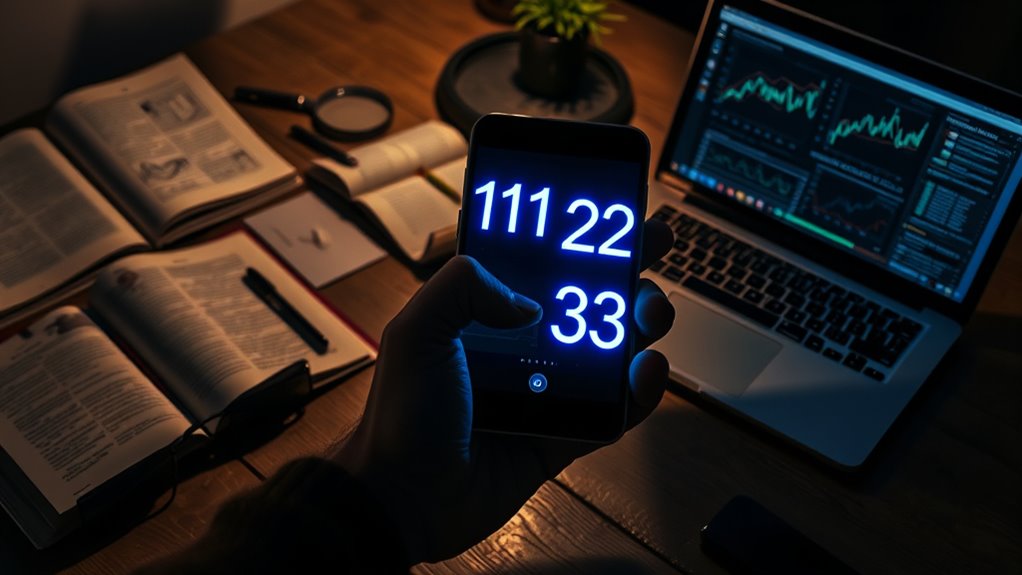

Skeptics and scientists generally view angel numbers as coincidence, influenced by cognitive biases like confirmation bias and pattern recognition. They say your frequent noticing of sequences like 111 or 444 is due to the brain seeking meaning, not divine messages. Without empirical evidence, these numbers are better explained by chance and perception rather than supernatural intent. To understand more about the scientific perspective and why your mind may assign special significance, keep exploring the facts behind these patterns.

Turn your wind-down time into listening time
- Thousands of audiobooks, podcasts and originals
- Listen on your phone, tablet or Echo — also offline
- Cancel anytime
Key Takeaways
- Many scientists view angel numbers as coincidence or psychological illusions rather than divine messages.
- Pattern recognition and cognitive biases, like confirmation bias, influence perception of significance in number sequences.
- Empirical evidence supporting angel numbers as meaningful or supernatural is lacking and difficult to verify scientifically.
- Frequent exposure to certain numbers increases perceived importance, often explained by attention and memory biases.
- Skeptics argue perceptions of divine messages stem from mental processes, not objective evidence or supernatural intervention.
Many scientists and skeptics dismiss the concept of angel numbers as mere coincidence or psychological illusion. They argue that the frequent noticing of specific number sequences, like 111 or 444, doesn’t necessarily indicate anything supernatural or divine. Instead, they focus on the importance of statistical validity, pointing out that humans naturally seek patterns in their environment. Our brains are wired to find meaning, even where none exists, which can lead us to overinterpret random occurrences. This tendency is rooted in cognitive biases such as confirmation bias, where we pay more attention to instances that support our beliefs while ignoring those that contradict them. When you start noticing certain number sequences regularly, it’s easy to convince yourself that they’re meaningful, but skeptics maintain that this is a classic example of how cognitive biases skew perception. Additionally, the human propensity to seek pattern recognition can exaggerate the significance of these numbers, further reinforcing mistaken beliefs. From a scientific perspective, the notion of angel numbers lacks empirical evidence. The idea that these numbers serve as divine messages is difficult to verify through objective means. When analyzing phenomena like these, researchers emphasize the importance of statistical validity—ensuring that observed patterns are not just products of chance. Without rigorous data, it’s impossible to distinguish between genuine signals and random noise. Many supposed encounters with angel numbers can be explained by the mere frequency with which people are exposed to certain sequences or by the human tendency to notice familiar patterns. If you’re repeatedly seeing a number, it might be because you’ve recently become more aware or are paying closer attention to it, rather than because it holds any special significance. Moreover, cognitive biases play a significant role in how individuals interpret these experiences. For instance, the availability heuristic makes you more likely to remember instances that seem meaningful while forgetting the countless times you saw similar numbers without assigning any significance to them. This selective memory reinforces the illusion that angel numbers are a form of divine communication. Skeptics argue that what many perceive as meaningful messages are simply products of the mind’s natural inclination to find order and purpose. They suggest that, instead of viewing these patterns as evidence of supernatural intervention, you should consider the psychological factors that influence perception and the lack of verifiable scientific support. In essence, what appears as a divine message often boils down to cognitive biases and the human craving for certainty, rather than any objective, statistical validity of angel numbers.
As an affiliate, we earn on qualifying purchases.
Frequently Asked Questions
Are There Cultural Differences in Interpreting Angel Numbers Worldwide?
You’ll find that cultural differences deeply influence how you interpret angel numbers worldwide. Cultural symbolism shapes the meaning you assign to specific numbers, while regional numerology practices guide your understanding. For example, in some cultures, certain numbers are considered lucky or unlucky, affecting your perception. By exploring these regional numerology traditions, you can better grasp diverse interpretations and develop a more nuanced view of angel numbers across different cultures.
How Do Psychological Factors Influence Belief in Angel Numbers?
You might believe in angel numbers because your brain loves shortcuts, thanks to cognitive biases like confirmation bias, which makes you see meaning where there is none. Your mental health also plays a role; if you’re anxious or seeking reassurance, you’re more likely to interpret repetitive numbers as divine messages. So, your mind’s quirks and emotional state can turn simple patterns into mystical signs, whether that’s scientifically sound or not.
Can Studies Prove a Causal Link Between Angel Numbers and Life Events?
Studies can’t definitively prove a causal link between angel numbers and life events because empirical evidence remains inconclusive. Causality research requires rigorous experiments and controlled conditions, which are lacking here. While you might notice patterns or correlations, these don’t establish causation. You should be cautious about interpreting angel numbers as direct causes of life changes, since current scientific methods haven’t validated such a connection.
What Role Do Social Influences Play in Adopting Angel Number Beliefs?
Social influences play a significant role in your belief in angel numbers through group conformity and authority influence. When you see friends or community members emphasizing their significance, you’re more likely to accept and adopt those beliefs. Authority figures or popular media also sway your perceptions, making you more receptive to angel numbers. This social pressure shapes your views, encouraging you to see patterns and assign meaning, even if evidence is lacking.
Are There Neurological Explanations for Perceiving Angel Numbers?
Imagine you keep seeing 111 everywhere. Neurologically, your brain’s neural patterns may favor recognizing familiar numbers, creating perceptual biases that make you notice them more. This phenomenon, called pareidolia, explains how your brain interprets random stimuli as meaningful. Your neural circuits are wired to find patterns, so when you focus on angel numbers, your perceptual biases heighten, making these numbers seem more significant than they objectively are.
Conclusion
As you consider angel numbers, remember that science views them as patterns your mind creates, much like a modern-day alchemist searching for hidden meaning in symbols. While skeptics see them as coincidence or cognitive bias, some find comfort in believing they’re messages from beyond. Just like the ancient mariner relied on stars to navigate, you can choose to see these numbers as guiding signs or mere coincidence—your perspective shapes your experience.
Halloween Picks
halloween
As an affiliate, we earn on qualifying purchases.